
What Is an Operational Healthcare CRM? A Complete Guide
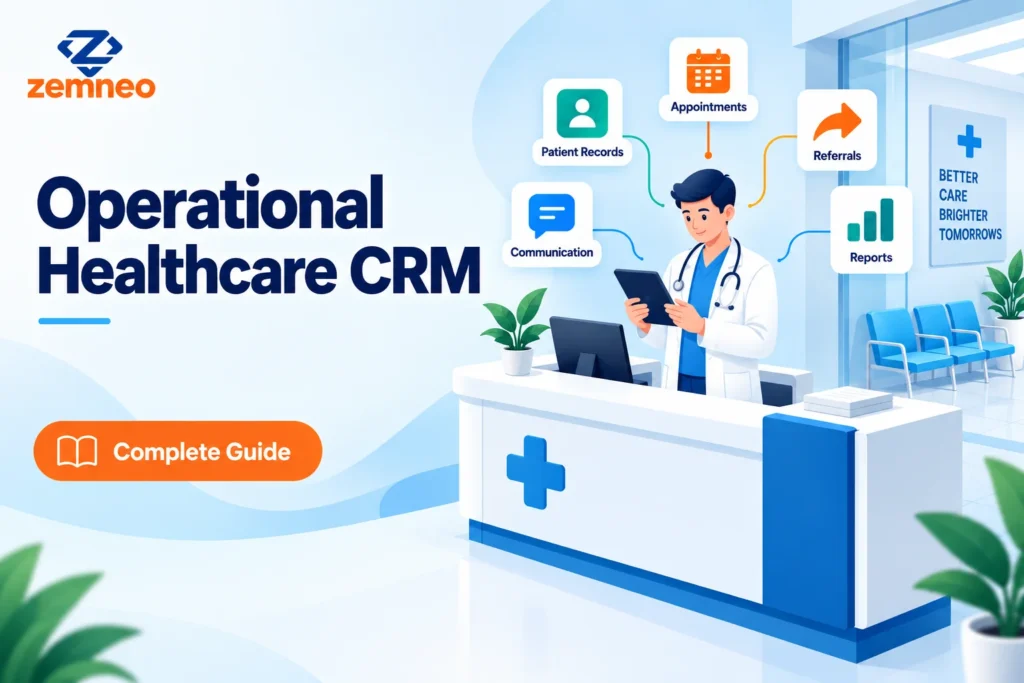
Every healthcare organization runs on a web of relationships: patients, referring doctors, insurance partners, and internal care teams, all of whom need to stay connected without anything slipping through the cracks. A CRM built for retail or SaaS sales was never designed to handle that kind of complexity. That gap is exactly what an operational healthcare CRM exists to solve.
This guide covers what CRM in healthcare really means, how it’s different from an EHR or ERP, the features and benefits that actually move the needle, and the mistakes organizations most commonly make when picking one.
What Does CRM Mean in a Healthcare Setting?
In most industries, a CRM exists to manage sales conversations and close deals. In healthcare, the job changes shape entirely. A healthcare CRM system pulls together every touchpoint a patient has with an organization, phone calls, emails, texts, web forms, chatbot conversations, into a single connected record, so no team is working off partial information.
Instead of tracking a sales pipeline, a healthcare CRM tracks a patient journey: symptom triage, referral coordination, appointment scheduling across multiple providers, and long-term engagement rather than a one-time purchase. See our Healthcare CRM Solution to see how this looks in practice.
What Exactly Is a Healthcare CRM?
A healthcare CRM is relationship management software shaped around the operational and regulatory realities of care delivery. Beyond storing contact details, a properly built system tracks clinical touchpoints, insurance and billing information, referral origin, and communication history, all built around coordinating care rather than closing a sale.
Demand for this kind of software has grown fast. Multiple industry analysts have tracked steady double-digit growth in the healthcare CRM market over the past several years, with adoption accelerating as organizations move away from managing patient relationships through spreadsheets and disconnected call logs.
Healthcare CRM vs EHR: What’s the Difference?
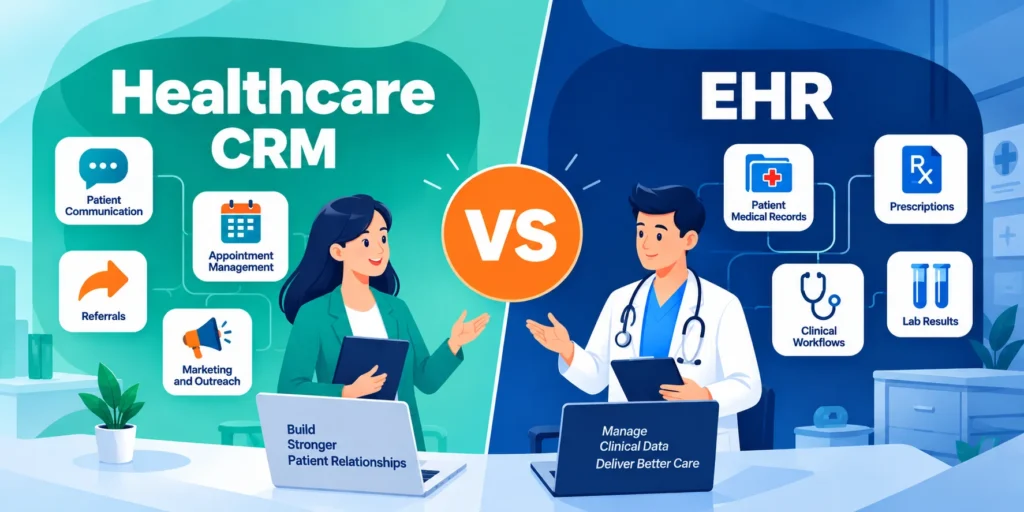
A question we hear constantly: is an EMR the same as a CRM? It isn’t, though the two work best side by side.
An Electronic Health Record (EHR), sometimes called an EMR, documents the clinical side of care: diagnoses, prescriptions, lab work, and treatment history entered by clinical staff. A healthcare CRM covers the operational and relationship side sitting around that clinical record: where a referral came from, how a patient prefers to be contacted, whether a reminder campaign led to a booked appointment.
Most EHR platforms were never built to automate outreach or measure marketing performance. That’s the layer a CRM adds, and it’s why the two systems complement each other instead of competing.
Healthcare CRM vs ERP
It’s worth separating CRM from ERP too, since the two get confused often. An Enterprise Resource Planning (ERP) system runs the back office: accounting, procurement, inventory, supply chain. A CRM runs the front office: everything related to how the organization interacts with patients.
Put simply, ERP keeps the organization functioning internally, while CRM keeps the organization connected to the people it serves. Some platforms bundle limited features from both, but neither should be treated as a replacement for the other.
Why Healthcare Needs a Purpose-Built CRM, Not a Generic One
It’s tempting to reuse whatever CRM the sales team already knows. In healthcare, that shortcut usually backfires.
Compliance isn’t optional. A HIPAA compliant CRM has encryption, access controls, and audit logging built into its foundation, not added on afterward. If the system will ever touch protected health information, HIPAA compliance stops being a nice-to-have and becomes a requirement from day one.
A patient record isn’t a lead record. A sales lead moves through a pipeline and eventually closes or disappears. A patient relationship is ongoing and carries sensitive information that demands a different standard of handling.
Referrals need a dedicated workflow. Few industries outside healthcare have a formal referral process where one provider hands a patient to another and both sides need visibility into that handoff. A generic CRM simply has no concept for this.
Care is a team effort, not a solo one. A single patient interaction might touch a front-desk coordinator, a nurse, a specialist, and billing staff. A healthcare CRM is structured around that shared ownership instead of one rep “owning” a deal.
The Core Features Worth Looking For
When comparing healthcare CRM software, these are the features that separate a purpose-built platform from a repurposed sales tool.
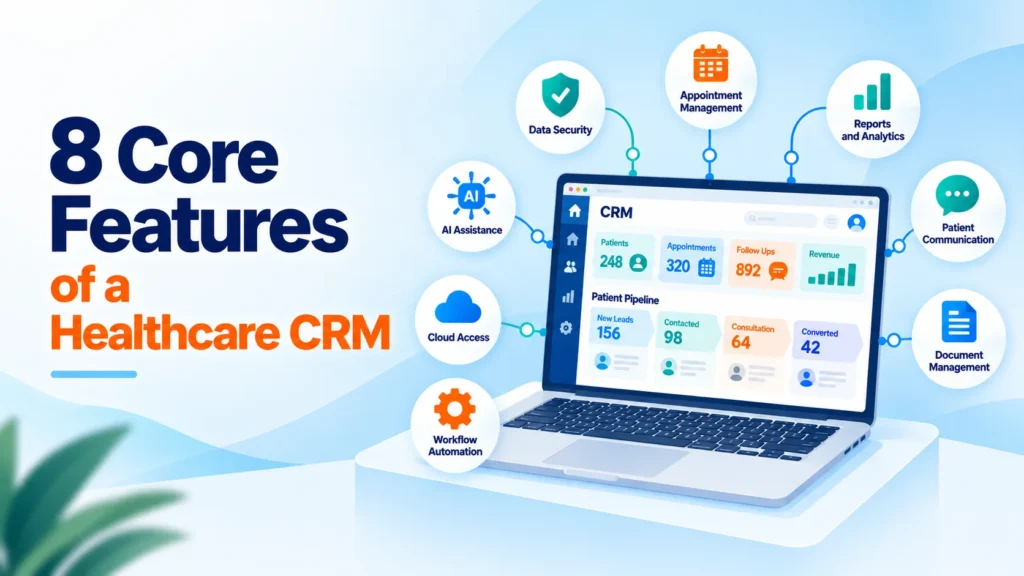
Unified patient records. One consistent source of truth means patients stop repeating the same information to every department they interact with.
EHR integration. Connecting clinical and CRM systems lets non-clinical staff understand a patient’s care context without needing full chart access, which improves both service and referral handling.
Automated workflows. Referral assignment, appointment scheduling, and follow-up reminders running automatically cut down the manual chasing that drives administrative burnout.
Built-in appointment scheduling. Patients should be able to book online, get automated reminders, and be routed to the right provider or location, with everything logged for future outreach.
Reporting and analytics. Dashboards tracking referral volume, appointment conversion, and satisfaction scores give leadership visibility that scattered spreadsheets never could.
AI-assisted tools. Generative AI features are increasingly showing up in healthcare CRM platforms to help staff search records faster and draft outreach, though human review of anything AI-generated from patient data still matters.
Service and support tools. A full patient view lets support staff tailor recommendations to a patient’s actual coverage, history, and preferences instead of guessing.
Marketing automation. Wellness reminders, educational content, and targeted campaigns can run directly from the CRM instead of a disconnected marketing platform.
Data security controls. Encryption in transit and at rest, role-based permissions, and multi-factor authentication protect sensitive data across every channel.
Document management. A searchable home for consent forms, billing records, and communication history tied to the right patient automatically.
Explore our CRM Features page for a full breakdown of how each of these works inside the platform.
What Organizations Actually Gain From a Healthcare CRM
- Faster patient acquisition, built on real behavioral and demographic insight rather than guesswork
- Deeper engagement, through outreach tied to documented needs like overdue screenings
- Stronger loyalty, since patients notice when communication feels personal instead of generic
- Real time savings, from automating repetitive administrative work
- More consistent messaging, across phone, email, text, and web from a single system
- Simpler compliance management, with workflows already structured around HIPAA requirements
- Better feedback capture, replacing low-response paper surveys with automated follow-up
- Smarter staffing decisions, using CRM data to see where demand is actually concentrated
Real-World Examples of Healthcare CRM in Action
A multi-specialty clinic logs every incoming referral, automatically routes it to the right department, and tracks whether the patient followed through on their first visit, flagging anything that’s gone quiet.
A surgical practice manages pre-op communication, tracks signed consent forms, and coordinates between the surgeon’s office, anesthesiology, and scheduling, all under one patient record. Read more in our upcoming guide on CRM for Surgical Services.
A telemedicine provider relies on automated appointment reminders and digital intake forms to cut down no-shows for virtual visits, while keeping in-person and virtual touchpoints in the same record.
A diagnostic lab tracks incoming orders from referring physicians, monitors turnaround times, and automatically notifies the ordering provider once results are ready. See our related guide on CRM for Medical Laboratories.
Are Hospitals Actually Using CRM Systems?
Yes, and adoption keeps climbing. Hospitals and larger health systems lean on CRM primarily to sharpen patient engagement and tighten day-to-day operations, coordinating communication, tracking interactions across every channel, and using satisfaction data to guide both service delivery and growth strategy. When organizations shortlist the best CRM for healthcare, referral tracking, built-in compliance, and clinical system integration now matter more than generic sales features.
Mistakes Worth Avoiding When Choosing a Healthcare CRM
Picking a generic sales CRM because it’s familiar or cheaper. The customization needed to force it into healthcare workflows often ends up costing more than a purpose-built platform from the start.
Treating compliance as something to bolt on later. Retrofitting compliance into a system that wasn’t designed for it is far more expensive than starting with one that was.
Skipping referral workflow support entirely. Without native referral tracking, teams fall back to spreadsheets, which defeats the point of having one system of record.
Leaving front-line staff out of the decision. A CRM chosen only by administrators, without input from the coordinators who’ll use it daily, usually sees weak adoption after launch.
Underestimating the need for reporting. Without analytics built in, leadership loses the ability to tell whether the CRM is actually improving operations or just adding another login.
FAQ’s
Is an EMR a CRM?
No. An EMR stores clinical data such as diagnoses, prescriptions, and treatment history. A CRM manages the business and relationship side, referrals, scheduling, and outreach. Most organizations run both together.
Do hospitals use CRM systems?
Yes. Hospitals increasingly rely on CRM to coordinate communication, track patient interactions across channels, and support both satisfaction and long-term growth goals.
What counts as a CRM system?
At minimum, a CRM centralizes patient data and interactions in one database, with contact management, automation, communication tracking, and reporting built in so teams always have a current view of the relationship.
Does a healthcare CRM need to be HIPAA-compliant?
If it touches protected health information, yes. Encryption, access controls, audit trails, and a signed Business Associate Agreement with the vendor should all be confirmed before any patient data enters the system.
Is an operational healthcare CRM only useful for large hospitals?
Not at all. Clinics, specialty practices, diagnostic labs, surgical centers, and telemedicine providers all rely on vertical healthcare CRM systems just as much as large hospital networks do.
Explore More Guides
- How to Improve Sales Performance: 15 Tips for Better Sales Results
- Zemneo CRM or Salesforce CRM: Which Fits Your Business Better?
- What Is the Primary Objective of the CRM Process? 7 Benefits
- ZemNeo CRM vs Zoho CRM: Which Is Better for Indian SMBs?
- What is Customer Master Data Management? Explained: 7 Powerful Benefits
