
What Is a Travel Agency CRM? Features, Uses, and How It Works
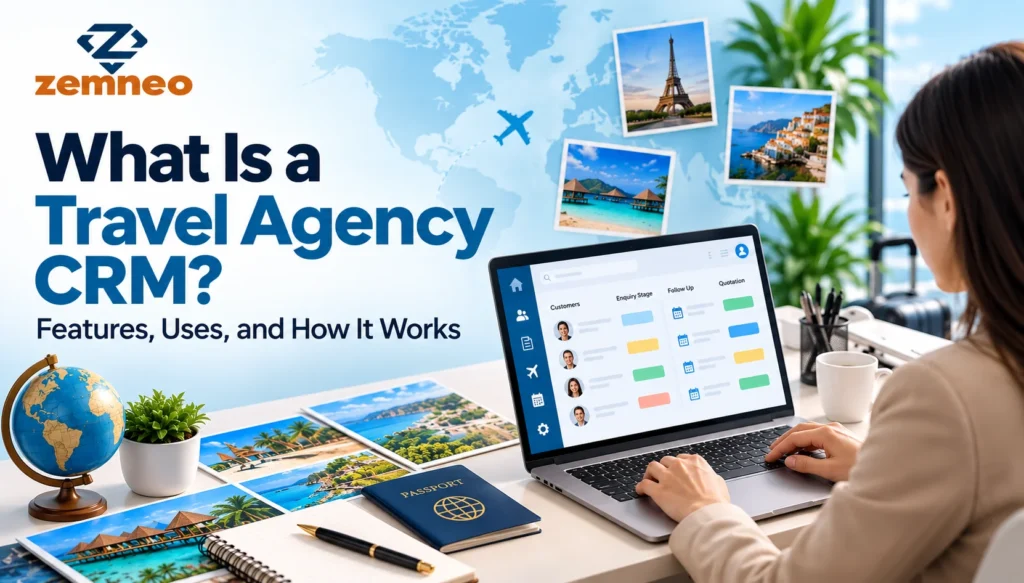
A family messages your agency on WhatsApp asking for a five-day Kerala package. Another customer fills in the website form for Dubai. A third calls about a Bali honeymoon, and your agent says, “I will send the quote tomorrow.” By Thursday, nobody remembers who was promised what, and one of those customers has already booked with someone else.
This is the daily reality for many small and mid-sized agencies, and it is exactly the problem a travel agency CRM is built to solve. It keeps every enquiry, quote and follow-up in one place, so your team always knows what to do next. At ZemNeo, we work with small businesses that face this same problem in different industries, and leads are usually lost because nobody tracked them.
This guide explains what a CRM is for a travel business, how it works, which features matter, and how to choose the right one.
What Is a Travel Agency CRM?
A travel agency CRM is software that records every customer enquiry, conversation, quotation and follow-up in one shared system. CRM stands for customer relationship management.
Think of it as a notebook your whole team can open, search and update. Open a traveller’s record and you see the destination they asked about, their budget, travel dates, who spoke to them last and what is due next.
Good travel CRM software is not a booking engine by default. Its first job is to manage relationships and sales activity. Booking, invoicing and similar functions depend on the product and how it is configured, so never assume them without asking.
Why Do Travel Agencies Need a CRM?
Travel selling is slow and personal. Customers compare packages, check with family, ask for changes and come back after a week. That gap between the first message and the final decision is where agencies lose business.
Without a CRM, this is what usually happens:
- Enquiries from WhatsApp, Instagram, phone calls and the website sit in different places.
- Follow-ups depend on an agent’s memory.
- Customer notes leave with the agent who quits.
- Owners cannot see how many enquiries are open or why deals were lost.
- Repeat travellers are treated like strangers.
A travel agent CRM gives each enquiry an owner, a status and a next step. In peak season, when messages double within a week, that structure matters even more.
How Does a CRM for Travel Agencies Work?
A CRM for travel agencies follows the path of an enquiry from the first message to the final outcome.
- Capture: An enquiry arrives from a form, call, WhatsApp message or ad, and a lead record is created. With the right integrations, this can happen automatically.
- Assign: The lead goes to an agent by rule (for example, all international enquiries to one person) or by hand.
- Qualify: The agent records destination, travel dates, group size and budget.
- Quote and follow up: The quotation is logged and a reminder is set.
- Close or learn: The lead is marked booked or lost, with a reason.
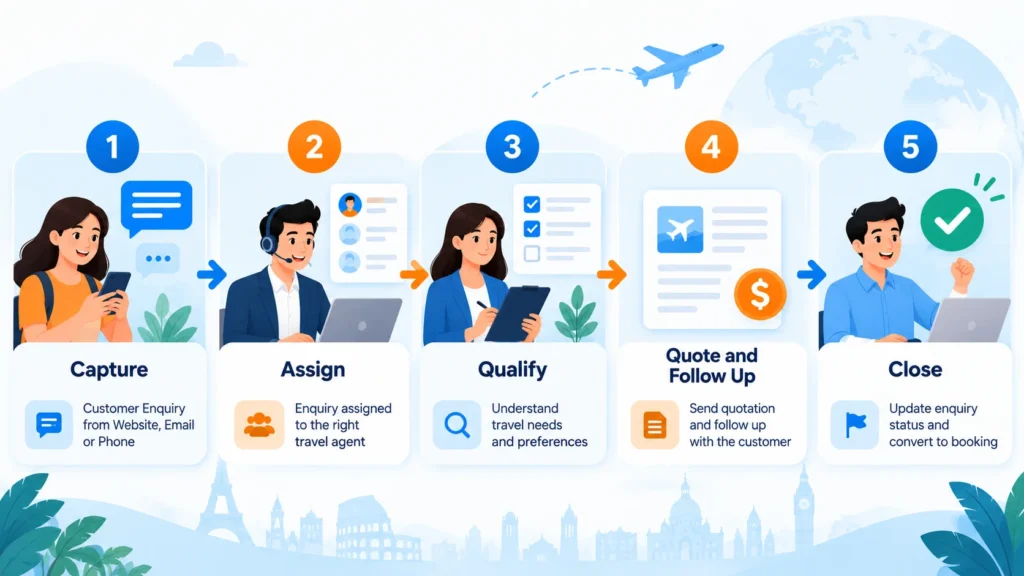
Each step leaves a trail, and that trail becomes your sales history.
Key Features of Travel Agency CRM Software
Travel CRM software varies between products, but these features matter most for a travel business.
Customer enquiry management
Every enquiry lands in one list with its source, destination and status. You can see which channel brings serious buyers and which brings only price checks. The lead management feature in ZemNeo is built for this kind of tracking, with leads captured from websites, social media and ads in a single view.
Traveller profiles and preferences
A profile holds contact details, family members, preferred hotels, food needs, past trips and dates such as anniversaries. When the same family returns, your agent starts with knowledge, not a blank page. Proper contact management keeps all of this together. Store sensitive documents only if the system offers role based access.
Follow-up and reminder management
Reminders turn good intentions into dated tasks. Overdue ones show up on the agent’s list and in the manager’s view. ZemNeo’s automation can assign new leads to the right person and trigger reminders on its own, which removes a lot of daily chasing.
Quotation and sales opportunity tracking
Each possible trip is an opportunity with a value and a stage: quote sent, negotiation, confirmed or lost. Our guide to opportunity pipeline management explains how these stages work.
Booking-related activity tracking
Agents can log what is pending against a customer: advance received, documents awaited, visa in process. Full booking management, payments, itinerary creation, ticketing and supplier integrations are not guaranteed in every CRM. Some products include them, some need custom setup, and some do not offer them at all. Travel CRM software should be judged on what it actually supports.
Customer communication history
Calls, WhatsApp chats, SMS and emails are saved on the customer record. With WhatsApp CRM integration, chats can sit beside the lead instead of on one agent’s phone.
Reports and dashboards
Travel CRM software reports show enquiries by source, conversion by agent, lost reasons and overdue follow-ups. If you are unsure how the two differ, read reports and dashboards: what is the difference.
A Practical Example: Managing a Customer’s Trip Enquiry
Neha messages on Monday morning about a four-night Jaipur and Udaipur trip for five people in December. The CRM creates a lead and assigns it to Rohit. He logs her budget of Rs 1.2 lakh, the dates, and a note that two travellers are senior citizens.
Rohit sends a quote that evening and sets a reminder for Wednesday. On Wednesday he calls, learns she wants a hotel with a lift, revises the quote and moves the stage to negotiation. On Friday Rohit is on leave, but a colleague opens the record, reads every note and finishes the conversation. Neha pays an advance, and the lead is marked confirmed.
Next October, a reminder prompts the agency to ask about a winter trip. This is how travel CRM software works in a normal week: no dropped details, no repeated questions.
How CRM Helps Travel Agents Manage Customer Follow-Ups
Most travel bookings are won in the follow-up, not the first reply. A simple rhythm works well: quote on day one, check-in on day three, and a fresh offer or date reminder on day seven.
With travel CRM software, each of these steps becomes a scheduled task. Agents see their day’s calls on one screen, and managers see what is overdue. Customer follow-ups by text can be automated too. Our post on CRM SMS integration and follow-ups shows how automated alerts reduce missed callbacks. ZemNeo also connects with calling systems.
CRM vs Spreadsheets for Travel Agencies
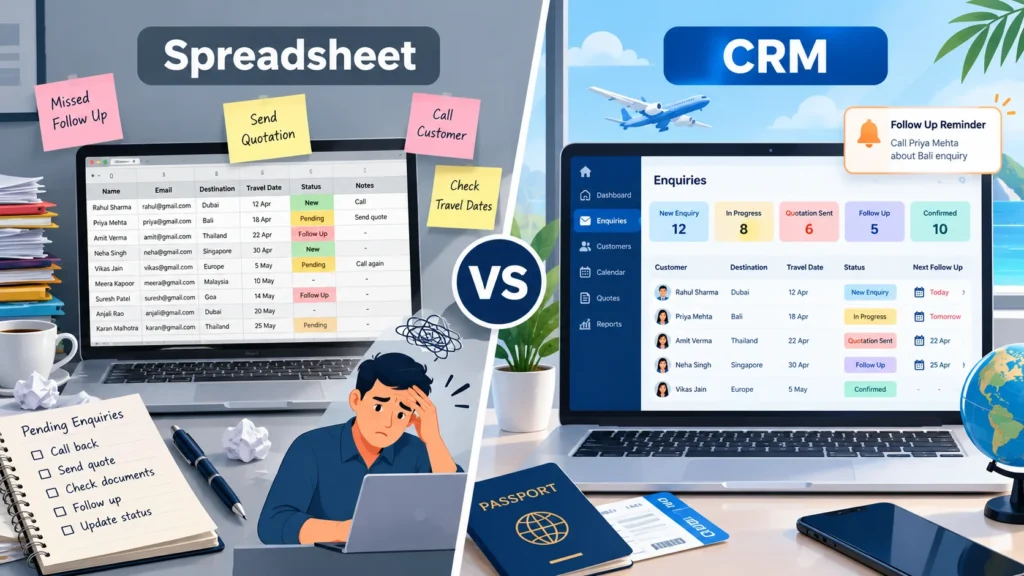
Spreadsheets work when you handle a handful of enquiries a week. Problems start as volume grows.
| Area | Spreadsheet | CRM |
|---|---|---|
| Reminders | Manual, easy to forget | Scheduled tasks with alerts |
| Team access | One file, version clashes | Shared records with permissions |
| History | Scattered notes | Full timeline per customer |
| Reporting | Built by hand | Ready reports and dashboards |
| Lead capture | Typed in manually | Can be automatic with integrations |
As a rough rule of thumb, once you have more than two agents or a steady flow of enquiries, a CRM usually pays for itself. Travel CRM software also protects you when staff change, because customer history stays in the system, not in someone’s personal phone.
How to Choose a CRM System for a Travel Agency
Use this checklist while comparing options:
- Ease of use: Agents should learn it in a day or two.
- Customisation: Pipeline stages, fields and forms should match how you sell. A customizable CRM adapts to your process.
- Channels: Check that WhatsApp, website forms and ad leads can flow in.
- Mobile access: Agents work on the move.
- Reports: You should see source, conversion and lost reasons.
- Access control: Limit who can see customer data.
- Support and pricing: Ask what setup, training and extra users cost.
Ask every travel CRM software vendor to demo your own process, not a generic one. ZemNeo is a customizable CRM that can be configured around a travel sales process, with its own pipeline stages, fields and follow-up rules. Its integrations cover WhatsApp, Facebook, Instagram, Google Ads and SMS, which are the channels most travel enquiries come from. It also has a hospitality CRM page for related businesses. If you want to see how it would look for your agency, you can book a free ZemNeo demo.
Common Mistakes When Using Travel CRM Software
Travel CRM software fails mostly because of habits, not features.
- Buying features the team will never use.
- Agents keeping notes on personal phones instead of the CRM.
- Skipping the lost reason, which hides why deals fail.
- Adding too many custom fields, so data entry becomes a chore.
- Having no owner who checks that data is updated.
- Assuming booking, payment or supplier features come built in.
The fix is simple. Start small, train the team on three or four daily actions, and review the dashboard weekly. Smaller travel CRM software setups that people actually use beat large ones nobody opens.
Conclusion
A travel agency CRM will not sell trips for you, but it makes sure no enquiry is forgotten. Start your travel CRM software with enquiry capture, follow-ups and a simple pipeline, then add more as the team gets comfortable. With a configurable system like ZemNeo, you can begin with the basics and shape the process around how your agents already work.
Frequently Asked Questions
1. What is a travel agency CRM?
A travel agency CRM is software that stores customer enquiries, conversations, quotes and follow-ups in one shared system, so the whole team can manage leads and relationships.
2. Why do travel agencies need a CRM?
Travel customers take days to decide. A CRM makes sure every enquiry has an owner and a next step, so leads are not lost between messages, calls and spreadsheets.
3. What are the main features of travel CRM software?
Common features are enquiry management, traveller profiles, reminders, quotation and opportunity tracking, communication history, and reports. Exact features depend on the product.
4. Can a CRM handle bookings and payments?
Not always. Booking, payments, itinerary creation, ticketing and supplier integrations depend on the software and its setup. Confirm with the vendor before buying.
5. Is a CRM better than Excel for a travel agency?
For a very small team, Excel can work. As enquiries and agents grow, a CRM gives reminders, shared history and reports that a spreadsheet cannot match.
6. How does a CRM help with customer follow-ups?
It sets reminders for each lead, shows overdue tasks to agents and managers, and can send automated messages through channels such as SMS and WhatsApp.
7. Is travel CRM software expensive for a small agency?
Prices vary widely. Many products charge per user per month, so a small team can start with a basic plan. Is travel CRM software worth it? If you lose enquiries today, usually yes.
8. How do I choose the right CRM for a travel agency?
Check ease of use, customisation, channel integrations, mobile access, reports, access control and support. A customizable option like ZemNeo can be set up around your own enquiry process, so ask for a demo using your real workflow.
