What Is Opportunity Pipeline Management? A Practical Guide

Every sales team has deals sitting at different points. Some are brand new. Some are close to closing. Some have gone quiet and nobody remembers why. Opportunity pipeline management is how you keep track of all of it, so deals move forward instead of getting lost in someone’s inbox.
This guide explains what opportunity pipeline management actually means, how it is different from lead management, the stages a deal moves through, and how growing businesses use it to close more deals without adding more staff.
What Is Opportunity Pipeline Management?
Opportunity pipeline management is the process of tracking every open sales opportunity from first contact to a closed deal. It gives your team a clear view of where each deal stands, what needs to happen next, and how likely it is to close.
Think of it as a map. Without a pipeline, a salesperson has to remember which prospects they called last week, who still needs a proposal, and who is ready to sign. With opportunity pipeline management, all of that lives in one place, usually inside a CRM opportunity management software, so nothing depends on memory.
For small and growing businesses, this matters even more. A single missed follow up can mean a lost sale, and most teams do not have the extra staff to double check every deal manually.
Why Opportunity Pipeline Management Matters for Growing Businesses
When a business is small, tracking a handful of deals in a notebook or a spreadsheet works fine. But once a team grows past a few salespeople, that system breaks down fast. Deals get duplicated, updates go untracked, and managers lose visibility into what is actually happening.
Good opportunity pipeline management fixes this by giving everyone the same view. A sales manager can see exactly how many opportunities are open, which stage each one sits in, and where deals are getting stuck. This makes it much easier to plan sales activities for the week, coach the team, and forecast revenue with real numbers instead of guesses.
It also protects the business when a salesperson leaves. If every opportunity lives in a shared system instead of one person’s head, the next rep can pick up right where the last one left off.
Sales Lead vs Sales Opportunity: What’s the Real Difference?
People often use these two words like they mean the same thing, but they describe different stages of the same journey.
A sales lead is someone who has shown some interest but has not been qualified yet. Maybe they filled out a form, downloaded a guide, or asked a question on WhatsApp. At this point, you do not know if they have the budget or the need to actually buy.
A sales opportunity is a lead that has been qualified. This means the person has a real need, some budget, and a reason to make a decision soon. Once a lead reaches this point, it moves into your opportunity pipeline, and the focus shifts from finding interest to closing the deal.
This is also where sales opportunity management becomes different from lead management. Lead management is about capturing and qualifying interest. Opportunity management is about moving a qualified prospect through demos, proposals, negotiation, and a final decision. Most CRMs, including ZemNeo’s Lead Management feature, handle the early stage, while a dedicated Opportunity Management feature takes over once a lead is qualified.
The Stages of an Opportunity Pipeline
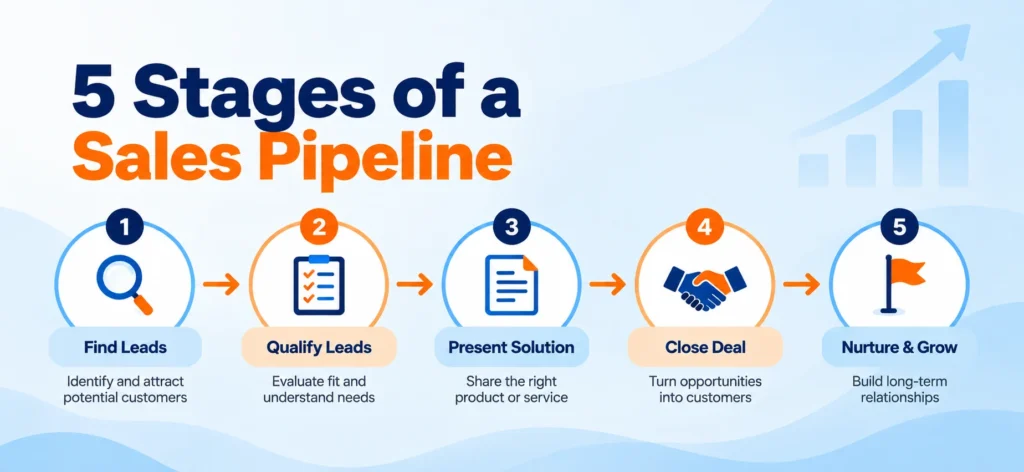
Most opportunity pipelines follow a similar set of stages, even if the exact names change from business to business. A common setup looks like this.
- New. The opportunity has just been created, usually pulled in automatically from a lead, an inquiry, a website form, or a campaign.
- Qualified. The lead has a real need and budget, and the deal is worth pursuing.
- Proposal. A price, plan, or quote has been shared with the prospect.
- Negotiation. Terms, pricing, or timelines get discussed and adjusted.
- Won or Lost. The deal either goes through or does not, and either way, the reason gets recorded for future reference.
Each stage should have a clear next step and a clear owner attached to it. If an opportunity sits in a stage for too long with no activity, that is usually a sign it needs attention, not an automatic sign that it is dead. Businesses that sell more than one product or serve more than one region often run separate pipelines side by side too, so a services team and a product team are not stuck sharing the same stage structure.
How to Track Sales Activities at Each Stage
Sales activities are the actual actions your team takes to move a deal forward: calls, emails, WhatsApp messages, meetings, demos, and follow ups. Tracking these activities inside your opportunity pipeline management system is what turns a static list of deals into something you can actually manage.
Here is a simple way to do it well.
Log every activity against the opportunity it belongs to, not just in a personal notebook. This way, if a manager or teammate needs to step in, they can see the full history in seconds.
Set a reminder for the next action every time you log an activity. A pipeline with no next step attached is just a list, not a working system.
Review overdue activities weekly. If several opportunities have no activity logged in the last two weeks, that is where your team should focus first.
Many businesses use automation to handle the reminder part, so no follow up is left to memory. Attaching proposals, quotes, and call notes directly to the opportunity also helps, since anyone picking up the deal later can see the full picture without digging through old emails. Our guide on how to improve sales performance covers more ways to keep your team consistent with follow ups.
What Is Average Deal Size and Why Should You Track It?
Average deal size is the typical value of a closed deal, calculated by dividing your total revenue from closed deals by the number of deals closed in a given period.
This number matters more than most teams realize. It tells you how many opportunities you actually need in your pipeline to hit a revenue target. If your average deal size is fifty thousand rupees and your monthly goal is five lakh rupees, you know you need roughly ten closed deals a month, which means your pipeline needs to hold far more open opportunities than that, since not every opportunity closes.
Tracking average deal size over time also shows you patterns. Maybe deals from referrals close at a higher value than deals from cold outreach. Maybe a certain industry consistently brings bigger contracts. This kind of insight only shows up when your opportunity pipeline management system is capturing deal values consistently, which is where reporting tools like ZemNeo’s Reports and Dashboards become useful.

Best Practices to Manage Your Opportunity Pipeline
A few habits separate teams that manage their pipeline well from teams that just have a pipeline sitting unused.
Keep stage names simple
If your team cannot agree on what “Proposal Sent” means versus “Negotiation,” they will enter data inconsistently, and your reports will not mean much.
Review the pipeline as a team, not just individually
A weekly pipeline review where the whole sales team looks at stuck deals together often uncovers blockers that one rep alone would miss.
Do not let old opportunities sit forever
If a deal has had no activity in a month, either revive it with a clear next step or mark it as lost. A pipeline full of dead deals makes your numbers look better than reality, which leads to bad forecasting.
Track win rate by stage, not just overall
Knowing that most of your lost deals happen at the negotiation stage tells you exactly where to improve, instead of guessing.
Connect your pipeline to how leads actually arrive
If most of your qualified opportunities come from WhatsApp or Google Ads, make sure those channels feed directly into your pipeline instead of requiring manual entry.
Choosing CRM Opportunity Management Software: What to Look For
Not every CRM handles opportunity pipeline management the same way. Some tools are built mainly for marketing and treat opportunities as an afterthought. If you are evaluating options, a few things are worth checking.
Look for software that creates opportunities automatically from leads, inquiries, website forms, or ad campaigns, instead of making your team enter every deal by hand. This alone saves a surprising amount of time once volume picks up.
Make sure pipeline stages can be customized to match how your team actually sells, and that the software supports more than one pipeline if you sell different products or serve different regions. A retail business and a manufacturing business rarely sell the same way, so a customizable CRM tends to fit better than a rigid one.
Check how deals get assigned to reps. Some software only allows manual assignment, while better systems support rules based on territory or round robin routing, so no opportunity sits unowned for days.
Confirm that reporting is built in, not something you have to export to another tool first. You should be able to see win rate, forecasted versus actual revenue, and stage wise deal values without extra work, and be able to pull those numbers as PDF or Excel when leadership asks for them.
Finally, confirm the software supports follow up automation, so reminders and lead assignment happen without manual effort. This is often the difference between a pipeline that gets used daily and one that gets ignored after the first month.
Common Mistakes That Slow Down Pipeline Management
Too many pipeline stages
If a deal has to pass through nine stages before closing, reps stop updating the system honestly because it feels like extra work.
No clear owner for each opportunity
When more than one person can touch a deal with no clear owner, follow ups get missed because everyone assumes someone else is handling it. Assignment rules based on territory or round robin routing solve this automatically instead of relying on someone to manually hand off every deal.
Ignoring stalled deals
Letting an opportunity sit untouched for weeks without a decision wastes time that could go toward active deals.
Not connecting the pipeline to marketing channels
If leads from ads or WhatsApp are not flowing directly into the pipeline, your team is doing manual data entry that could be automated.
Skipping the post sale stage
Closing a deal is not the end. Following up after the sale often leads to repeat business, something a proper account management process helps with.
Frequently Asked Questions
What is the difference between a sales lead and a sales opportunity?
A sales lead is someone who has shown interest but has not been qualified. A sales opportunity is a lead that has a real need, a budget, and a reason to decide soon, which moves it into your active pipeline.
How many stages should an opportunity pipeline have?
Most businesses do well with four to six stages. Too many stages make the pipeline hard to manage, while too few make it hard to know where a deal actually stands.
What is average deal size and how do I calculate it?
Average deal size is your total revenue from closed deals divided by the number of deals closed in a period. It helps you figure out how many opportunities you need in your pipeline to hit a revenue goal.
Is opportunity management the same as CRM?
No. A CRM is the overall system that manages contacts, leads, and customer data. Opportunity management is one part of a CRM that focuses specifically on tracking deals as they move toward closing.
What sales activities should be tracked in a pipeline?
Calls, emails, WhatsApp messages, meetings, demos, and proposal sends should all be logged against the opportunity they relate to, so the full history is visible to anyone who needs it.
Why do opportunities get stuck in one stage for a long time?
Usually because there is no clear next step, no owner following up, or the prospect has gone quiet without a resolution. A weekly pipeline review helps catch this early.
Can small businesses benefit from opportunity pipeline management, or is it only for large sales teams?
Small businesses benefit the most, since a single missed follow up has a bigger impact when there are fewer deals in total. A simple pipeline with clear stages prevents that.
What is win rate and why does it matter?
Win rate is the percentage of opportunities that close successfully out of all opportunities that reach a decision. Tracking it by stage shows exactly where deals are being lost.
Does opportunity pipeline management help with sales forecasting?
Yes. Since every opportunity has a stage and an estimated value, you can estimate future revenue based on how many deals are open and how likely each stage is to close.
What should I look for in CRM opportunity management software?
Look for customizable pipeline stages, integration with the channels your leads come from, built in reporting, and automation for reminders and lead assignment.
Want to see opportunity pipeline management in action? Explore ZemNeo’s Opportunity Management feature or book a free demo to see how it fits your sales process.
Recent Posts