ZemNeo vs HubSpot: Which CRM Should You Pick?
If you’ve been looking for a CRM, ZemNeo vs HubSpot is a comparison you’re likely to come across. HubSpot is a big name with a free plan, recommended by many blogs. But once you compare the features you actually need against the cost of scaling up, things can get confusing.
That’s when business owners start looking at other CRM options. ZemNeo is one to consider, especially if you want essential CRM features without paying for a setup that’s more than you need.
Let’s look at both CRMs in plain terms, no sales talk, just what each one offers, where it works well, and where it falls short.
What HubSpot Is Really Built For
HubSpot started with a strong focus on inbound marketing and later expanded into a broader CRM platform, with tools for marketing, sales, and customer support. Larger businesses with dedicated teams often choose it because they can manage different customer-facing activities from one place.
But that “all in one place” approach can also mean higher costs as your needs grow. HubSpot offers a free plan, but advanced features, automation, reporting, and higher usage limits are available only on paid plans. For a lean team or a growing coaching center, paying for features they may not need can be difficult to justify.
There’s also a learning curve. With such a wide range of settings and features, teams new to CRMs can take time to understand the platform and set it up properly.
This is one of the first differences you’ll notice when comparing ZemNeo vs HubSpot.
ZemNeo vs HubSpot: How ZemNeo Is Different
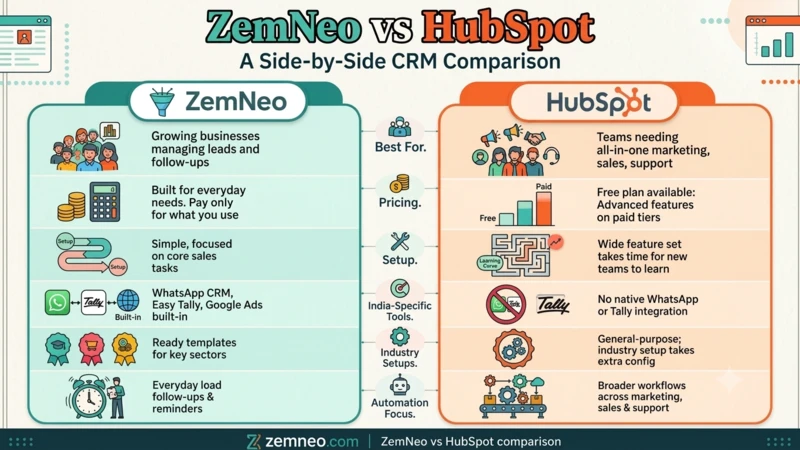
ZemNeo was built with a simple goal: help growing businesses manage leads and follow-ups without needing a technical expert to set up their CRM software. Instead of covering every possible marketing and support function, ZemNeo focuses on the core CRM needs businesses use to manage their sales process.
One thing that stands out is how it fits your business, instead of forcing your business to fit the software. With a customizable CRM setup, pipelines, forms, and processes can be configured around how your team already works, rather than a fixed template.
New software can be difficult to adopt when teams have to change familiar processes just to match the tool. Being able to configure the system around existing workflows makes the transition easier.
ZemNeo vs HubSpot: Pricing and Overall Cost
Price is often an important factor, especially when CRM costs increase as your needs grow.
HubSpot has a free plan, but many advanced sales, automation, and reporting features are available on paid plans. As your business grows and you need more features, contacts, or users, the overall cost can be harder to justify for a lean team.
ZemNeo is designed with growing businesses in mind. Its focus is on everyday CRM needs such as lead tracking, follow-ups, and reports, rather than a large set of marketing and support tools that every business may not need.
For a business working with a limited budget, the difference comes down to what you need from a CRM and what you’re willing to pay for it. This is an important factor when comparing ZemNeo with HubSpot.
Setting It Up and Using It Daily
HubSpot has a clean, modern interface, but that doesn’t always mean every feature is easy to find. With such a wide range of tools and settings, new users may need time to understand the dashboard and set it up for daily work.
ZemNeo keeps the focus on core CRM tasks. Features such as lead management and task management help teams manage the basic steps of a sales process: who the lead is, what needs to be done next, and who’s handling it.
For a business owner already juggling hiring, operations, and daily work, a CRM that’s easy to set up can save time. Simplicity is often more useful than extra features the team may never use.
The Missing Piece for Indian Businesses
This is an important point for Indian businesses comparing CRM options. Many already use WhatsApp to communicate with customers and Tally for accounting, so a CRM that works with these tools can make daily operations easier.
ZemNeo is built around these common business tools, offering integrations with WhatsApp CRM, Google Ads, and Easy Tally, along with Facebook, Instagram, and SMS.
For businesses that get most of their enquiries through WhatsApp, this is especially useful. Instead of manually moving customer details between WhatsApp, spreadsheets, and the CRM, teams can manage everything in one connected workflow.
Setups Made for Your Line of Work
HubSpot is a general-purpose CRM that can be customized for different types of businesses, though industry-specific setups may need additional configuration time.
ZemNeo offers ready setups designed around common industry processes, including education CRM, retail CRM, healthcare CRM, and finance CRM.
For example, a coaching center may need to manage admissions, batches, and student enquiries. An industry-specific setup reduces the need to build every process from scratch, making the system easier to adapt to the business.
Automatic Reminders: Both Have It, But the Focus Is Different
HubSpot offers a wide range of automation tools, including workflows for marketing, sales, and customer communication, useful for teams managing detailed marketing and sales processes.
ZemNeo focuses more on everyday sales follow-ups. Leads can be assigned to the right team member, follow-up reminders keep sales teams on track, and WhatsApp or SMS communication can be managed as part of the process.
The difference is mainly in focus. HubSpot offers broader automation across business functions, while ZemNeo helps businesses manage leads and follow-ups without adding unnecessary complexity.
So, Which One Should You Pick?
When it comes to the ZemNeo vs HubSpot decision, here’s the honest answer: it depends on your business.
If you run a company with a dedicated marketing team, a larger budget, and detailed marketing and sales campaigns, HubSpot’s wider range of tools may be a good fit.
If you’re a growing business that mainly needs to manage leads, follow up on time, and connect tools such as WhatsApp, Google Ads, and Tally, ZemNeo may be the better fit for your day-to-day CRM needs.
The ZemNeo vs HubSpot choice isn’t just about which CRM has more features. It’s about choosing a system that matches your team, your workflow, and the tools you already use. You can also read more comparisons and setup guides on the ZemNeo blog.
FAQs: ZemNeo vs HubSpot
1. How do I know if my business needs a CRM?
If you’re managing leads on spreadsheets, missing follow-ups, or struggling to track where each customer stands in your sales process, it’s usually a sign you need a CRM. Growing teams especially benefit once manual tracking starts causing missed opportunities.
2. What’s the difference between a CRM and just using spreadsheets?
A CRM automates follow-ups, tracks every interaction with a lead, and shows your team where each deal stands, things spreadsheets can’t do at scale. As your customer base grows, manual tracking becomes harder to manage and more error-prone.
3. What should I check before choosing a CRM for my business?
Look at your budget, team size, and whether the CRM supports tools you already use daily, such as WhatsApp or accounting software. It also helps to check ease of setup, customer support quality, and whether the CRM can grow with your business.
4. Is ZemNeo cheaper than HubSpot?
ZemNeo is designed for growing businesses that need essential CRM features such as lead management, follow-ups, and reports. HubSpot offers a free plan, while advanced sales, automation, and reporting features sit on paid tiers. When comparing ZemNeo vs HubSpot pricing, the total cost depends on the features, contacts, and users your business needs, but ZemNeo generally works out more budget-friendly for lean teams.
5. Which is better for Indian businesses, ZemNeo or HubSpot?
The right option depends on your business needs and existing tools. Businesses that rely on WhatsApp and Tally daily may find ZemNeo’s integrations useful, while HubSpot offers a broader range of marketing, sales, and customer service tools for more complex requirements.
Final Thought
There’s no CRM that’s better for every business. The ZemNeo vs HubSpot choice depends on how your team works, what features you need, and what fits your budget. HubSpot suits businesses that need a broad set of marketing, sales, and support tools, while ZemNeo focuses on the everyday CRM needs of growing businesses.
If you’re still deciding, seeing the CRM in action is more useful than comparing feature lists alone. You can book a free demo to see how ZemNeo handles lead management and follow-ups before making your final decision.
