How to Improve Sales Performance: 15 Tips for Better Sales Results

Trying to sell more but not seeing the results you want? You are not alone. Most sales teams hit a point where effort does not match results. Reps make calls, send messages, and still miss their numbers month after month. The good news is that you do not need a bigger budget or a bigger team to fix this. You need better habits, clearer tracking, and the right tools working together.
In this guide, you will find 15 simple, practical tips to improve sales performance. These are not complicated theories pulled from a textbook. They are steps any sales team, big or small, can start using today, without changing everything about how they work.
Why Sales Performance Drops in the First Place
Before we get to the tips, it helps to understand why sales performance slips in the first place. Most teams lose deals not because their product is bad, but because of small, fixable problems that pile up over time. Leads sit unanswered for too long. Follow-ups get forgotten in the middle of a busy day. Customer data lives in five different places instead of one, so no one has the full picture. Reps spend more time searching for information than actually talking to customers.
None of these problems are about talent or effort. They are about process. A hardworking rep with no system behind them will still lose deals to small, avoidable mistakes, simply because there is too much to track by memory alone. Once you fix these small gaps, sales performance naturally improves, often faster than teams expect, because the fixes remove friction rather than adding more work.
The tips below cover the full sales process, from the first conversation with a customer to the tools that support your team behind the scenes. You do not need to apply all fifteen at once. Pick the ones that match your biggest current problem, whether that is slow follow-ups, messy tracking, or a team that has not reviewed its approach in a while, and build from there.
1. Know Your Customer Before You Pitch
Do not start a sales call with a script. Start with research. Look at what the customer needs, what problems they face day to day, and what they have already tried to solve those problems. Spend five minutes checking their website, their industry, or their past conversations with your team before you call.
A pitch that speaks to a real problem always beats a generic one that could apply to anyone. Customers can tell within the first minute whether you understand their situation or are reading from a script. Even a short note like “I noticed your team recently expanded, so I imagine managing more customer inquiries has become harder” shows you did your homework and instantly sets you apart from a cold, generic opener. This single habit alone can improve sales performance more than any script or sales tool ever will.
2. Set Clear, Daily Sales Goals
Big monthly targets can feel far away and hard to act on. A goal of closing fifty deals this month does not tell a rep what to do this morning. Break these big numbers into daily actions instead. How many calls today? How many follow-ups are due? How many new leads need a first response?
Daily goals keep the team focused on what matters right now and make it easier to track sales performance day by day, instead of waiting until month end to find out how things went. When a rep falls behind on a Tuesday, they can adjust on Wednesday, rather than discovering the problem three weeks too late.
Write these daily numbers somewhere visible, on a whiteboard, a shared sheet, or inside your CRM dashboard, so the whole team sees progress in real time. Visible goals tend to get met more often than goals that only exist in someone’s head.
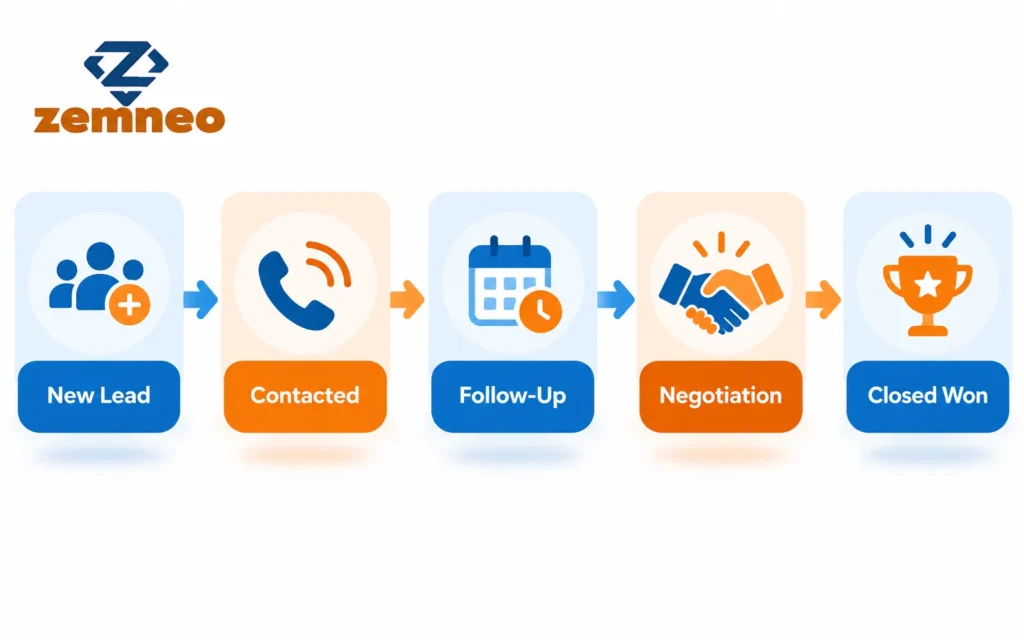
3. Why Fast Lead Follow-Up Matters So Much
Speed wins deals more often than price or product features do. A lead that waits more than a few hours often loses interest, gets busy with something else, or moves on to a competitor who replied first. This is one of the most common and most avoidable reasons sales performance suffers across entire teams.
Using a lead management system helps your team see new leads the moment they come in, instead of finding them buried in an inbox hours later. Every lead gets assigned to a specific person, so nothing sits waiting for someone to notice it. Fast follow-up is one of the easiest ways to improve sales performance without changing anything else about your process.
4. Keep Every Deal in One Place
If your team tracks deals in notebooks, spreadsheets, and WhatsApp chats all at once, something will always get missed. One rep forgets to update a spreadsheet. Another loses track of a conversation in a personal chat. Managers end up guessing at real numbers instead of knowing them.
A single CRM software system keeps every lead, call, and deal update in one dashboard that the whole team can see. This removes a huge amount of confusion and helps everyone stay on the same page, from new reps to senior managers, without extra meetings just to figure out where things stand.
It also protects the business when a rep leaves or goes on leave. If all the deal history lives in one person’s notebook or personal phone, that knowledge walks out the door with them. When it lives in a shared system instead, another team member can pick up the deal without starting from zero.
5. Automate the Tasks That Eat Your Time
Reminders, follow-up messages, and status updates take up hours every week when done by hand. A rep might spend an entire morning just sending the same update to ten different leads, one at a time. That is time not spent actually selling.
CRM automation can send these reminders and updates on its own, based on simple rules your team sets once. A new lead gets an instant welcome message. An overdue follow-up triggers a reminder automatically. Less manual work almost always means better sales performance across the whole team, since reps get their time back for real conversations.
6. Practice Active Listening on Every Call
Many salespeople talk too much and listen too little. They are so focused on covering every feature that they miss what the customer is actually trying to say. Let the customer speak first. Ask about their goals and their concerns before jumping straight into features and pricing.
When customers feel heard, they open up more, share their real budget, and tell you what is actually stopping them from buying. Trust builds naturally from this, and trust is what closes deals, far more than a polished presentation ever could.
A simple way to practice this is to pause for two full seconds after the customer finishes speaking before you respond. It feels awkward at first, but it stops reps from interrupting and gives the customer room to add one more important detail they might have held back.
7. Ask Better Questions, Not More Questions
It is not about asking many questions. It is about asking the right ones at the right time. Instead of a closed question like “Are you interested?”, try an open one like “What problem are you trying to solve right now?” The second question gives you real information to work with.
Better questions lead to better answers, and better answers help you understand exactly what the customer needs, so you can close the right deals faster instead of chasing every lead the same generic way.
8. How to Handle Objections With Confidence
Every salesperson hears “it’s too expensive” or “we need to think about it” at some point. Do not panic or argue back right away. Take a breath and ask what is really behind the objection. Is it truly the price, or is it uncertainty about whether the product will actually work for them?
Handling objections calmly, instead of defensively, keeps the conversation open instead of shutting it down completely. Most objections are really questions in disguise, and answering the real question behind them often turns a hesitant lead into a closed deal.
9. Track Your Sales Pipeline Every Day
A pipeline you do not check regularly is a pipeline that quietly leaks deals without anyone noticing until it is too late. Deals sit in one stage for weeks with no one following up, and by the time someone checks, the customer has already moved on.
Use opportunity management tools to see exactly where every deal stands, what stage it is in, and what needs to happen next to move it forward. Checking this daily, even for five minutes over morning coffee, keeps nothing from slipping through unnoticed and keeps sales performance steady across the month.
10. Use a Task List So Nothing Gets Forgotten
Sales reps juggle many things at once: calls, emails, meetings, paperwork, and internal updates. Without a clear task list, small but important actions get missed in the noise of a busy day, even by reps who work hard and mean well.
Task management tools let reps see exactly what needs attention today, what is due this week, and what is already overdue and needs urgent action. This turns a chaotic to-do list into something manageable, one task at a time.
11. Review Your Sales Reports Every Week
You cannot improve what you do not measure. Set aside time each week, even just thirty minutes, to look at sales reports and dashboards as a team. Which reps are closing the most deals, and what are they doing differently? Where are leads dropping off in the pipeline?
Weekly reviews help you catch problems early, while there is still time to fix them, instead of finding out at the end of the quarter when the numbers are already final and nothing can be changed. Keep these reviews short and focused on two or three clear actions for the coming week, rather than turning them into long meetings that eat into actual selling time.
12. Build Trust Before You Try to Sell
People buy from people they trust, not just from products that look good on paper. Be honest about what your product can and cannot do, even if that means admitting a limitation. Share real examples and real numbers from actual customers instead of vague promises.
A little honesty upfront prevents a lot of lost trust later, when a customer discovers the product does not do something you implied it could. Trust built early tends to lead to longer relationships and repeat business, not just a single sale.
13. Personalize Every Follow-Up Message
A copy-paste follow-up message feels cold, and most customers can spot one instantly. It gets ignored or deleted within seconds. Use the customer’s name, mention what you actually discussed last time, and keep the tone natural, like a real person wrote it.
Tools like WhatsApp CRM integration make it easy to send quick, personal follow-ups without losing the human touch, even when you are managing dozens of leads at once. A small personal detail in a message can be the difference between a reply and silence.
14. Keep Your Product and Pricing Information Accurate
Nothing kills a deal faster than giving a customer the wrong price or outdated product details, especially after they have already agreed to move forward. It creates doubt and makes the whole process feel unprofessional, even if the mistake was small.
Keep your product and pricing information updated and easy for every team member to access, so every quote your team sends is accurate the first time, without needing a manager to double check it.
15. Keep Learning New Sales Skills
Sales techniques that worked five years ago may not work the same way today. Customers research more before they call, compare options more carefully, and expect faster, more informed responses. Read one article, watch one video, or attend one training session a month.
Even small updates to your approach keep you sharp and help you improve sales performance steadily over time, instead of staying stuck at the same level while competitors adapt and move ahead. Encourage your team to share what they learn with each other too, so one person’s new idea can quietly improve the whole team’s results, not just their own.
Bringing It All Together
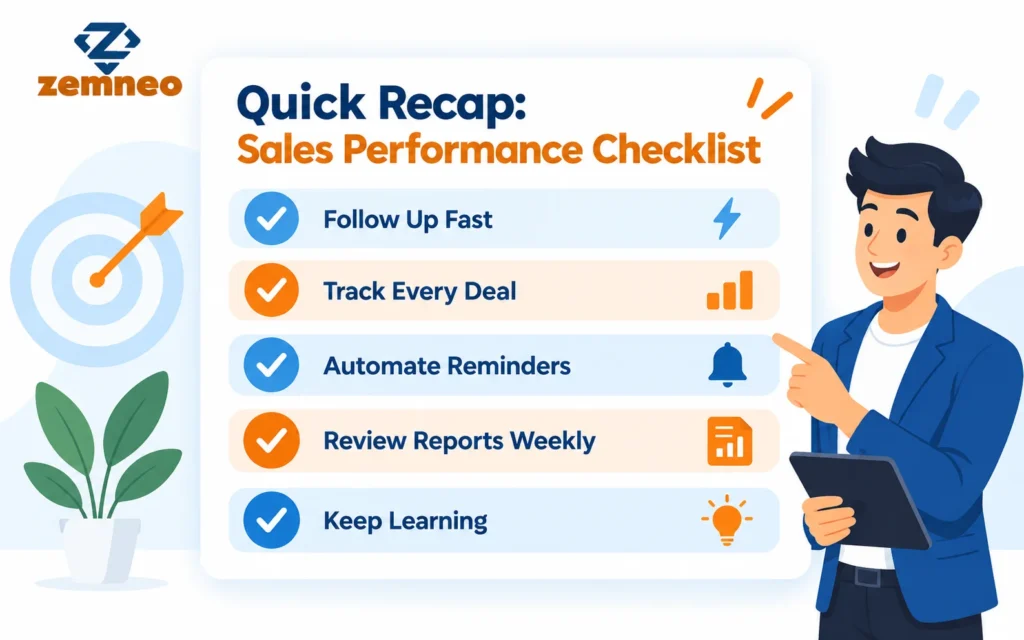
Improving sales performance is not about one big change or one new tool that fixes everything overnight. It is about small, steady improvements: responding faster, tracking better, listening more, and using the right tools to support your team instead of slowing them down with extra steps. Start with two or three tips from this list, build the habit until it feels natural, then move on to the next one.
If your team is still managing leads, follow-ups, and deals across scattered tools and spreadsheets, it may be time for a system built specifically to support better sales performance. ZemNeo CRM brings lead management, automation, task tracking, and reporting into one simple platform, so your team can spend more time selling and less time searching for information across different apps.
None of these fifteen tips require a complete overhaul of how your team works. Pick one this week, give it a real try for a month, and measure the difference before adding the next one. Over a few months, these small, steady changes add up to sales performance that keeps improving instead of staying flat.
FAQ’s: How to Improve Sales Performance
Q1: What does it mean to improve sales performance?
It means helping your sales team close more deals through better habits, like faster follow-ups, clearer tracking, and improved communication with customers.
Q2: What is the fastest way to improve sales performance?
Responding to new leads quickly is usually the fastest way. Leads that wait too long often go cold or move to a competitor.
Q3: How does a CRM help improve sales performance?
A CRM keeps every lead, deal, and follow-up in one place, so nothing gets missed and your team always knows what to do next.
Q4: How often should sales reports be reviewed to track performance?
Weekly reviews work best for most teams. They help you catch problems early instead of waiting until the end of the month or quarter.
Q5: Can small sales teams use these tips too?
Yes. These tips work for teams of any size, from a single salesperson to a large sales department.
Q6: What is the biggest mistake that lowers sales performance?
Slow or missed follow-ups are one of the most common mistakes. Many deals are lost simply because no one followed up on time.
Q7: Does automation really help improve sales performance?
Yes. Automation handles repetitive tasks like reminders and follow-up messages, freeing up time for your team to focus on actual selling.
Q8: How long does it take to see better sales performance after making changes?
Small changes, like faster follow-ups, can show results within a few weeks. Bigger changes, like adopting a CRM, may take one to two months to show their full impact.
Q9: Should every sales rep track their own performance?
Yes. When reps track their own numbers, they notice patterns faster and can adjust their approach before small issues become big problems.
Q10: What tools help sales teams stay organized?
Lead management, task management, and reporting tools, all in one CRM platform, help sales teams stay organized and focused on selling.
More CRM and Sales Tips for Your Business