What is Customer Master Data Management? Explained: 7 Powerful Benefits
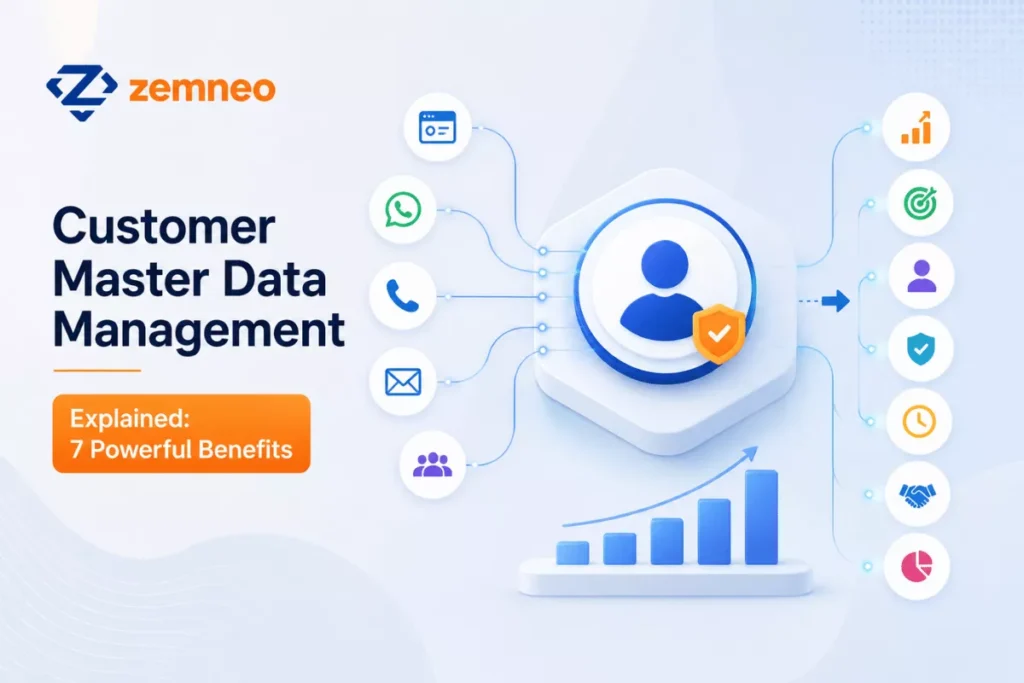
What is Customer Master Data Management? Explained in simple terms: it is the structured process of keeping important customer information accurate, consistent, complete, and usable across the systems a business relies on.
A customer may appear in a CRM, billing system, spreadsheet, marketing platform, ecommerce system, or customer-support database. When those records do not match, teams can end up working with different versions of the same customer.
For example, one system may contain an old phone number while another has the customer’s updated number. A sales representative may create a second record because the original one is difficult to find. Marketing may then send duplicate communication to the same person.
Customer master data management helps businesses reduce these problems by creating a more reliable customer record and establishing rules for how that information should be maintained.
Oracle describes customer master data management as a way to consolidate, clean, complete, and coordinate customer information from multiple sources, including resolving duplicate records and standardizing information.
What Is Customer Master Data?
Before understanding customer master data management, it helps to separate customer master data from everyday customer activity.
Customer master data is the core information that identifies and describes a customer. Depending on the business, this may include:
- Customer name
- Phone number
- Email address
- Company name
- Billing or business address
- Customer type
- Account information
- Contact information
- Relevant customer identifiers
An order, invoice, WhatsApp conversation, sales call, or support ticket is usually a transaction or interaction rather than the core customer master record.
The distinction matters because a business may have thousands of interactions but still struggle to answer a basic question: Which records actually belong to the same customer?
ZemNeo Tip: ZemNeo’s Contact Management helps businesses organize customer contact information in a structured CRM environment, making it easier for teams to work from organized customer records rather than disconnected lists.
What is Customer Master Data Management? Explained With a Simple Example
Imagine a small business called Aarav Home Solutions.
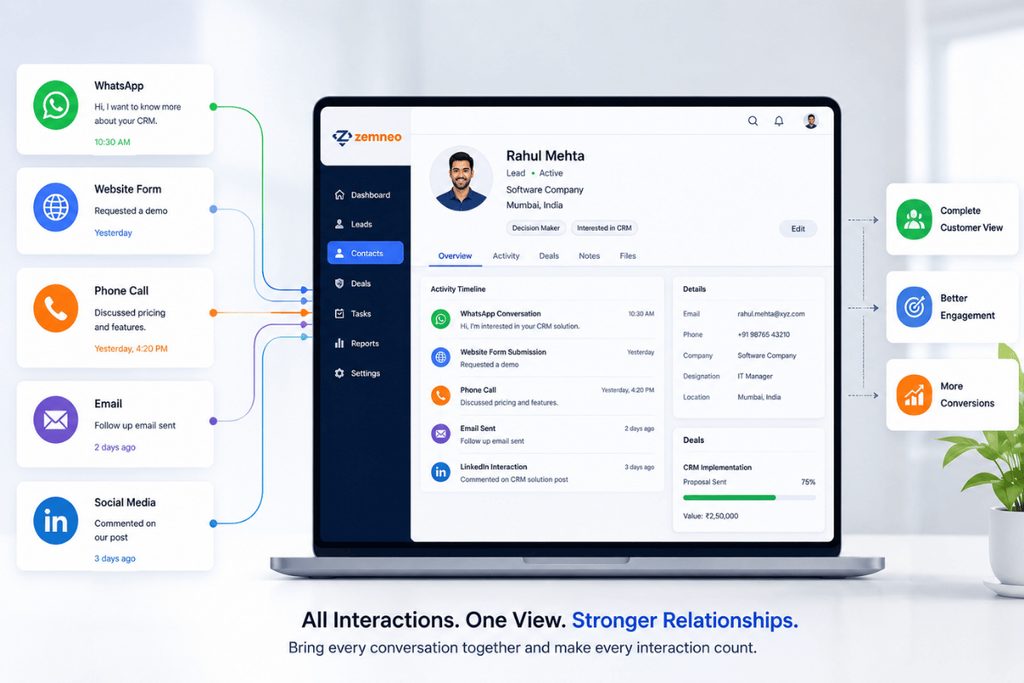
The business receives enquiries through its website, WhatsApp, Facebook, Instagram, and phone calls. A customer named Rahul Mehta contacts the business through WhatsApp first and later fills out a website form.
Without a structured customer-data process, the team could create two separate records:
| Record | Information |
|---|---|
| Rahul Mehta – WhatsApp | Phone number, enquiry details |
| R. Mehta – Website | Email, company name, enquiry details |
The business may actually be dealing with the same person.
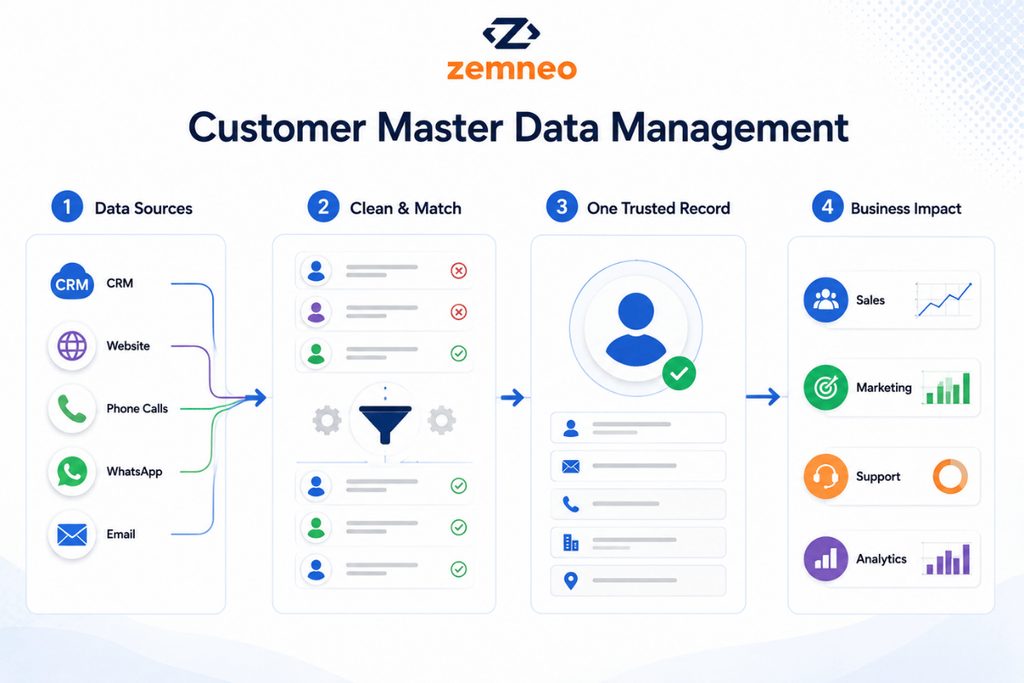
Customer master data management aims to identify these records, standardize the information, and establish one trusted customer record that other processes can use.
This is often described as creating a single source of truth or a golden record. IBM explains that MDM brings critical data together and helps reduce fragmentation, duplication, and inaccuracies across systems.
The basic flow
Multiple customer sources → Clean and standardize data → Match duplicate records → Maintain a trusted customer record → Use it across business processes
The important point is that customer master data management is not simply about putting everything into one spreadsheet. It is about establishing a repeatable way to identify, maintain, and use reliable customer information.
Why Customer Master Data Management Matters
Customer data becomes more difficult to manage as a business adds more channels, employees, products, and customer touchpoints.
A duplicate customer record may look like a small problem, but repeated across hundreds or thousands of records, it can affect sales activity, reporting, communication, and customer service.
Here are some of the most important benefits.
1. Creates a More Reliable Customer View
When customer information is spread across systems, employees may not know which record is current.
A well-managed customer master record gives teams a consistent reference point. Sales, marketing, and customer-facing employees can work with information that is easier to trust.
This is particularly useful when a customer interacts with a business through several channels.
2. Reduces Duplicate Customer Records
Duplicate records can happen because of spelling differences, different phone numbers, outdated email addresses, or simple human error.
For example:
- Amit Sharma
- Amit K. Sharma
- A. Sharma
These could represent three people—or one person.
Customer master data management uses matching and data-cleaning processes to identify such situations and reduce unnecessary duplication.
3. Improves Data Consistency
One system may store an Indian phone number as +91 98765 43210, while another stores it as 09876543210.
Both may refer to the same customer, but inconsistent formatting makes searching and matching harder.
Standardizing customer information makes it easier for teams and systems to recognize records consistently.
4. Supports Better Customer Service
Customer service becomes difficult when employees cannot quickly understand who the customer is and what information is current.
A reliable customer record can give the team better context before they respond.
This does not mean every interaction belongs inside the master record. Instead, the master record provides the stable customer identity around which different interactions can be organized.
5. Helps Sales Teams Work More Effectively
Sales teams depend heavily on accurate customer information.
If a salesperson contacts an old number, creates a duplicate account, or misses information stored elsewhere, the problem is not simply a data problem—it can become a sales problem.
A structured CRM process can connect customer records with leads, opportunities, tasks, and follow-ups.
ZemNeo Tip: ZemNeo’s Lead Management helps small businesses organize incoming leads and move them through a structured process. This becomes especially useful when enquiries arrive from several channels.
6. Makes Reporting More Meaningful
Imagine a business has 2,000 customer records, but 300 are duplicates.
A report based on those records may not accurately represent the customer base.
Cleaner customer data gives reports and dashboards a stronger foundation because the underlying records are more consistent.
ZemNeo’s Reports & Dashboards can help businesses review CRM information through organized reporting instead of relying entirely on manually prepared spreadsheets.
7. Creates a Stronger Foundation for Growth
Small businesses often begin with spreadsheets because they are easy to use.
The problem appears when the business grows and customer information starts moving between salespeople, marketing channels, communication platforms, and operational systems.
At that point, maintaining reliable customer data manually becomes increasingly difficult.
A structured approach to customer data helps the business build processes that can continue as customer volume increases.
How Does Customer Master Data Management Work?
A practical customer master data process generally involves several connected steps.
Step 1: Identify Customer Data Sources
Start by listing where customer information currently exists.
For example:
- CRM
- Website forms
- Spreadsheets
- Ecommerce systems
- Marketing platforms
- Billing systems
- Customer-support systems
- Phone records
The objective is not to immediately move everything into one system. First, understand where the data actually lives.
Step 2: Define the Important Customer Fields
Decide which information is essential for identifying and managing customers.
For one business, phone number and email may be critical. For another, company name, account type, location, and business contact may be more important.
This is where businesses should avoid collecting fields simply because they are available.
A useful customer-data field is one that supports a real business process.
Step 3: Clean the Existing Records
Look for:
- Missing information
- Incorrect formats
- Outdated contact details
- Duplicate records
- Inconsistent names
- Invalid email addresses
- Incorrect phone numbers
Cleaning is usually the least glamorous part of data management, but it is one of the most important.
Step 4: Match and Resolve Duplicates
The business then needs rules for deciding when two records represent the same customer.
For example, matching may consider a combination of:
Phone number + email + customer name + company
Using multiple fields is generally more reliable than matching on name alone.
Step 5: Establish Ownership and Rules
Someone needs to be responsible for maintaining customer information.
A simple governance process can define:
- Who can create customer records?
- Who can edit important fields?
- Which fields are mandatory?
- How are duplicate records handled?
- How often is data reviewed?
- Which system is treated as the primary source?
Without clear ownership, even clean data can become inconsistent again.
Step 6: Keep Customer Information Updated
Customer data management is not a one-time cleanup project.
A phone number changes. A company moves offices. A customer changes roles. An account gets reassigned.
The process needs to support these changes without creating another duplicate record.
Customer Master Data vs CRM: Are They the Same?
No. They are closely related, but they solve different problems.
A CRM is primarily designed to help businesses manage customer relationships, sales activities, leads, opportunities, communication, and related processes.
Customer master data management focuses more specifically on creating and maintaining reliable customer master information across systems and processes.
Think of it this way:
| CRM | Customer Master Data Management |
|---|---|
| Manages customer relationships and sales processes | Manages the quality and consistency of core customer data |
| Tracks leads, opportunities, tasks, and interactions | Identifies, cleans, matches, and maintains customer records |
| Helps sales and customer-facing teams work efficiently | Helps create a consistent customer record across systems |
| Supports day-to-day relationship management | Supports data consistency and governance |
The two can work together rather than being competing concepts.
For a small business, a well-structured CRM can provide a practical foundation for maintaining customer records while also managing the sales and follow-up processes connected to those customers.
See how ZemNeo organizes customer information and sales processes → Explore ZemNeo Features
Common Customer Master Data Management Challenges
Even businesses that understand the value of clean data can run into practical problems.
Duplicate Records
Duplicate records are one of the most common issues. They can arise when different employees create customer profiles without checking existing records.
Incomplete Information
A customer record with only a name and phone number may not provide enough context for a complex sales process.
Data Silos
When customer information is spread across different platforms, employees may see only part of the relationship.
Inconsistent Data Entry
Different employees may enter the same information in different formats.
Lack of Ownership
If nobody is responsible for data quality, errors can gradually accumulate.
Outdated Information
Old contact information can remain in databases long after the customer has changed their details.
The solution is not necessarily to make every employee responsible for manually checking every record. Better results usually come from designing a process that prevents common errors from occurring repeatedly.
How a CRM Can Support Better Customer Data Management
A CRM does not automatically solve every master-data problem. The quality of the process still matters.
However, a customizable CRM can give small businesses a structured environment for organizing customer information and connecting it with daily sales activities.
For example, ZemNeo provides:
- Contact Management
- Account Management
- Lead Management
- Opportunity Management
- Task Management
- Product Management
- Reports & Dashboards
- Role Based Access
Businesses can also create custom pipelines, fields, forms, and workflows around their specific processes.
For example, a business could create a custom customer field for information that matters to its sales process, while using role-based access to control which team members can work with particular CRM information.
ZemNeo also supports integrations with WhatsApp, Google Ads, Facebook, Instagram, SMS, Tally, and CTI calling, which can help businesses connect customer-facing processes with their CRM environment.
The objective should be simple: make useful customer information easier to organize and use without turning data management into another manual burden.
A Practical Example for a Small Business
Consider a small education business that receives enquiries through Google Ads, Facebook, WhatsApp, and website forms.
Before using a structured CRM process, the team might maintain separate spreadsheets for enquiries and existing customers.
A prospective student may appear in one spreadsheet under a full name and in WhatsApp under a phone number. Another employee may create a second entry after receiving a follow-up call.
With a structured CRM process, the business can capture leads, assign them to the appropriate team member, schedule follow-ups, manage the opportunity, and maintain contact information in one organized environment.
The important improvement is not simply having another database.
The improvement comes from connecting customer information with the actions the team needs to take next.
ZemNeo Tip: ZemNeo can automate lead assignment and follow-up reminders, while WhatsApp and SMS automation can support communication workflows. This helps turn customer data into an actionable sales process rather than leaving information sitting unused.
Best Practices for Managing Customer Master Data
A good customer data process should be practical enough for employees to follow every day.
Keep One Clear Customer Identification Method
Define which fields help your team recognize an existing customer. Phone number, email, company name, or another business-specific identifier can be used as part of the matching process.
Make Important Fields Consistent
Use agreed formats for phone numbers, customer types, locations, and other important fields.
Avoid Unnecessary Data Collection
More fields do not automatically mean better customer data. Only collect information that supports a business requirement.
Review Duplicate Records Regularly
Do not wait until reporting becomes unreliable. Make duplicate review part of normal data maintenance.
Connect Data With Business Actions
Customer information becomes more valuable when it helps employees decide what to do next—whether that means following up, updating an opportunity, completing a task, or contacting a customer.
Control Access Carefully
Not every employee needs access to every customer record or field. Appropriate access controls can help businesses maintain better data discipline.
Frequently Asked Questions
What is Customer Master Data Management?
Customer Master Data Management is the process of creating, maintaining, and governing reliable customer information across business systems. It focuses on reducing duplicate, incomplete, inconsistent, and outdated records so teams can work from a more trustworthy customer view.
Why is Customer Master Data Management important?
It is important because customer information is often spread across multiple systems and channels. Without a consistent approach, businesses can create duplicate records, use outdated contact details, produce unreliable reports, and give customers inconsistent experiences.
Is Customer Master Data Management the same as CRM?
No. A CRM focuses mainly on managing customer relationships, sales activities, leads, opportunities, tasks, and interactions. Customer master data management focuses on the accuracy, consistency, matching, and governance of core customer information. They can complement each other.
What is a customer golden record?
A customer golden record is a trusted, consolidated version of a customer’s core information. Instead of maintaining several conflicting records for the same person or organization, the business aims to maintain one reliable customer view.
Can small businesses use customer master data management?
Yes. Small businesses may not need an enterprise-scale MDM platform to adopt better customer-data practices. They can start by standardizing important fields, reducing duplicate records, defining ownership, and using a CRM that supports structured customer management.
How does a CRM help with customer data?
A CRM can provide a structured place to manage contacts, accounts, leads, opportunities, tasks, and related information. With customizable fields and workflows, businesses can adapt the system to their own customer-management process.
Key Takeaways
- Customer master data is the core information that identifies and describes customers.
- Customer Master Data Management helps keep that information accurate, consistent, complete, and usable.
- Duplicate records and inconsistent information can affect sales, service, communication, and reporting.
- A trusted customer record provides a stronger foundation for day-to-day business processes.
- CRM and customer master data management are related but serve different purposes.
- Small businesses can improve customer data quality by using clear fields, ownership rules, structured processes, and appropriate CRM tools.
- ZemNeo combines customer management with leads, opportunities, tasks, automation, reporting, and integrations to help small businesses build a more organized CRM process.
Build a More Organized Customer Data Process With ZemNeo
Good customer data should help your team work faster and make better decisions—not create another spreadsheet that someone has to maintain manually.
With ZemNeo’s customizable CRM, small businesses can organize contacts, leads, accounts, opportunities, tasks, and customer-related processes while adapting pipelines, fields, forms, and workflows to their own way of working.
Book a Free Demo and see how ZemNeo can fit your customer-management process.
External Resources
For additional background on master data management, see the guidance from IBM: What is Master Data Management? and Oracle: What is Master Data Management?.