ESP vs CRM: What’s the Difference and Why It Matters
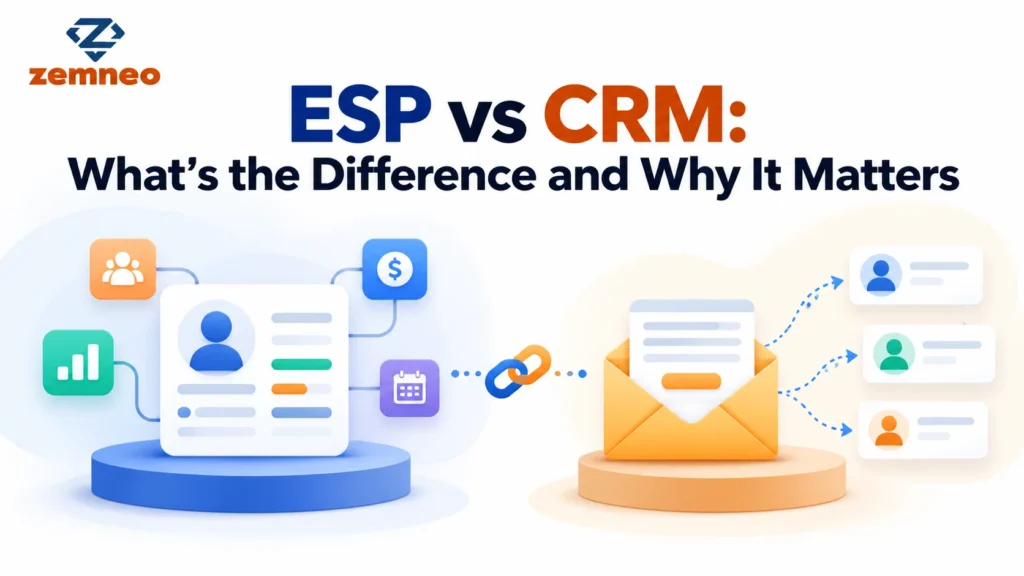
An ESP and a CRM can both play a role in customer communication, but they are built for different jobs. An ESP, or Email Service Provider, is mainly used to manage email campaigns, subscribers, automation, and email engagement. A CRM, or Customer Relationship Management system, manages customer and prospect information, sales activities, follow-ups, opportunities, and broader customer relationships.
Understanding the difference between CRM and ESP becomes important when a business starts using email marketing alongside lead and customer management. One system focuses on email communication, while the other keeps the wider customer journey organized.
This guide explains the difference between ESP vs CRM, how each system works, where they overlap, and how they can work together.
What Is an ESP?
An ESP, or Email Service Provider, is a platform designed for sending and managing email communication at scale.
Businesses commonly use an ESP to:
- Send newsletters and email campaigns
- Manage email subscribers
- Create automated email sequences
- Segment email audiences
- Schedule campaigns
- Track opens, clicks, and other available engagement data
- Manage email templates
- Measure campaign performance
For example, a business may use an ESP to send a welcome series after someone subscribes to its newsletter.
The difference between CRM and ESP becomes clear here: an ESP is primarily concerned with email communication and campaign delivery.
What does ESP stand for in marketing?
ESP stands for Email Service Provider.
In marketing, an ESP helps businesses organize subscribers, send email campaigns, automate messages, and measure email engagement.
An ESP is therefore mainly focused on communicating with an audience through email.
What Is a CRM?
A CRM is designed to organize and manage customer and prospect relationships.
A CRM can store and connect information such as:
- Contact details
- Lead information
- Customer accounts
- Sales opportunities
- Follow-up activities
- Tasks
- Communication history
- Sales pipeline stages
- Customer notes
The difference between CRM and ESP is that a CRM is not limited to email. It can manage the wider relationship between a business and its customers or prospects.
For example, a salesperson may use a CRM to see when a lead entered the business, which salesperson owns it, what was discussed, what stage the opportunity is in, and when the next follow-up is due.
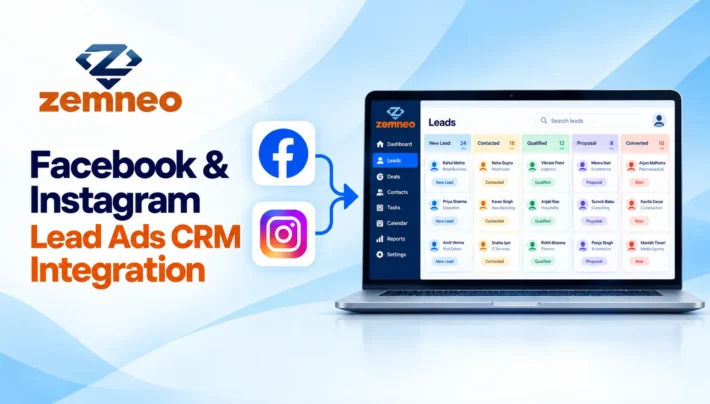
ZemNeo’s CRM features include lead management, contact management, opportunity management, task management, automation, and reporting, showing how a CRM can support several parts of the customer and sales process.
ESP vs CRM: What’s the Difference?
The easiest way to understand the difference between CRM and ESP is to compare their main purpose.
| CRM | ESP |
|---|---|
| Manages customer relationships | Manages email communication |
| Stores customer and lead information | Manages email subscribers |
| Tracks sales opportunities | Manages email campaigns |
| Handles tasks and follow-ups | Supports email automation |
| Records customer activity | Tracks email engagement |
| Supports sales workflows | Supports email marketing workflows |
| Gives teams customer context | Gives marketers email campaign data |
In simple terms, a CRM answers:
Who is this customer, what has happened, and what should happen next?
An ESP answers:
Who should receive this email, what should we send, and how did the audience respond?
That is the core difference between CRM and ESP.
CRM vs ESP: A Simple Example
Imagine a potential customer fills out a form on a company’s website.
The CRM may store:
- Name
- Company
- Phone number
- Email address
- Lead source
- Assigned salesperson
- Opportunity stage
- Follow-up date
- Previous conversations
The ESP may use the person’s email address to send:
- A welcome email
- Educational content
- A newsletter
- A follow-up sequence
- A campaign related to their interests
This example makes the difference between CRM and ESP easier to see.
The CRM manages the relationship and sales context. The ESP manages email communication with the audience.
How Does an ESP Work?
An ESP usually works around an email list or audience.
A basic process looks like this:
Subscriber joins → Audience is organized → Campaign is created → Email is sent → Engagement is measured
For example, a company may collect newsletter subscribers through its website. It can then divide subscribers into groups and send relevant campaigns to each group.
An ESP is especially useful when a business needs specialized email campaign management.
This is another important part of the difference between CRM and ESP. An ESP is built around email delivery and engagement, while a CRM is built around customer information and relationships.
How Does a CRM Work?
A CRM follows the broader customer journey.
A simple CRM process may look like:
Lead captured → Lead assigned → Contact made → Opportunity created → Follow-up → Sale → Customer management
The CRM keeps these activities connected.
For example, a new enquiry can enter the CRM, get assigned to a salesperson, move through different pipeline stages, and receive scheduled follow-ups.
ZemNeo also focuses on automated lead assignment and follow-up reminders, helping teams keep repetitive CRM activities organized.
This shows another practical difference between CRM and ESP: a CRM can manage the sales process around a customer, not just the emails sent to that customer.
Do You Need Both a CRM and an ESP?
Not every business needs both.
An ESP may be enough for a business that mainly needs newsletters, email campaigns, subscriber management, and email automation.
A CRM becomes more useful when the business needs to manage:
- Leads
- Customers
- Sales opportunities
- Follow-ups
- Team ownership
- Customer history
- Sales pipelines
Businesses with both strong sales and email marketing requirements may benefit from using both systems.
The difference between CRM and ESP does not mean they have to work separately. In many cases, they can support different parts of the same customer journey.
How Do CRM and ESP Work Together?
A CRM and ESP can work together when relevant customer and marketing information is shared between the two systems.
A simple workflow could look like:
Lead captured → CRM → Audience segment → ESP → Email campaign → Engagement → CRM
For example, a visitor may download an educational guide. The CRM can keep the lead information, while the ESP can send a related email sequence.
If the prospect later becomes a sales opportunity, the CRM can continue managing the sales process.
ZemNeo’s CRM integrations connect CRM workflows with tools and communication channels used by businesses, helping bring relevant activities into a more connected workflow.
Understanding the difference between CRM and ESP is useful here because each platform has a different role. The CRM manages customer context, while the ESP handles specialized email communication.
What Is CRM and ESP Integration?
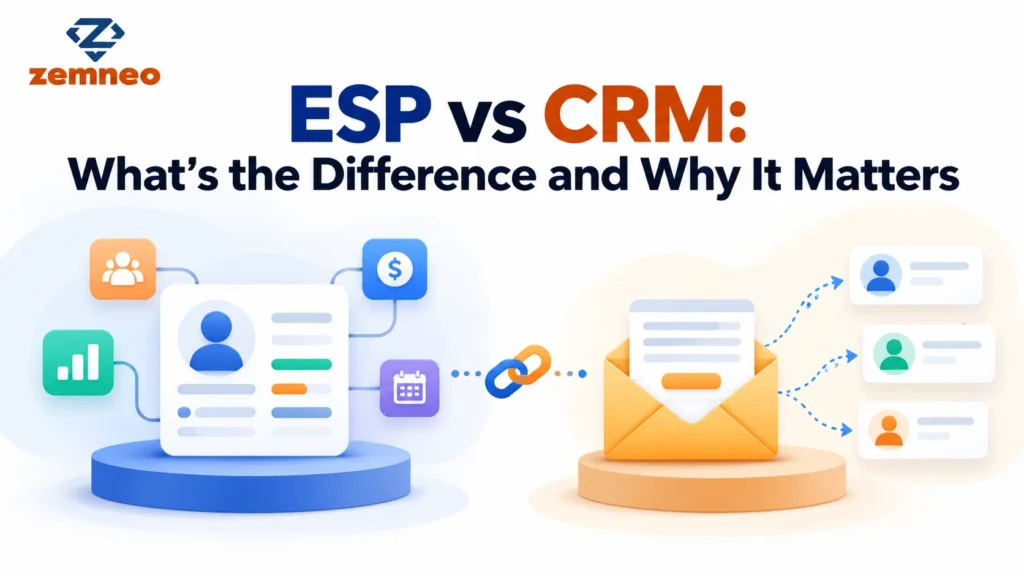
CRM and ESP integration means connecting relevant CRM information with an email marketing platform.
Depending on the systems being connected, useful information may include:
- Contact details
- Lead status
- Customer type
- Audience segment
- Campaign information
- Email engagement
- Relevant customer activity
The goal is not to move every piece of information between systems. The goal is to share useful information that improves segmentation, personalization, automation, or follow-up.
The difference between CRM and ESP still exists after integration. Integration simply allows the two systems to exchange useful information.
How Does ESP Integration Work With CRM?
A typical integration can follow these steps:
1. Customer information enters the CRM
A lead may come from a website form, advertising campaign, social media, referral, or another source.
2. The lead is organized
The CRM can store relevant information and identify the lead’s stage or status.
3. Relevant information reaches the ESP
Depending on the integration, selected information can be used for audience segmentation or email automation.
4. The ESP sends the email
The ESP handles campaign delivery and email engagement tracking.
5. Useful engagement can support the next action
If relevant engagement data is available to the CRM, the sales or marketing team can use it as part of the next step.
This workflow shows why knowing the difference between CRM and ESP matters before setting up an integration. You need to understand what each system should handle before deciding what information should move between them.
How Email Marketing CRM Integration Can Help
Email marketing CRM integration can connect marketing communication with customer information.
For example, a business could organize audiences based on customer or lead information and send different content to each group.
A simple structure could be:
| Audience | Possible Email Content |
|---|---|
| New leads | Educational information |
| Active prospects | Product or comparison content |
| Existing customers | Helpful tips and updates |
| Inactive contacts | Re-engagement content |
The CRM provides useful customer context, while the ESP handles the email campaign.
The difference between CRM and ESP therefore becomes an advantage rather than a problem. Each system can focus on the job it was designed to do.
CRM and ESP in Content Marketing
Content marketing is one area where both systems can support the same customer journey.
For example:
Blog post → Guide download → CRM record → Email sequence → Lead engagement → Sales follow-up
The CRM can help the business understand where a person is in the customer journey. The ESP can deliver educational content based on the audience or campaign.
For a deeper look at this use case, see ZemNeo’s article on how an ESP and CRM work together in content marketing.
That article focuses on how the two systems work together in content marketing, while this article focuses on the difference between CRM and ESP.
Common Mistakes to Avoid
Treating a CRM and ESP as the same tool
The difference between CRM and ESP should be clear to the teams using them. A CRM manages broader customer and sales information, while an ESP specializes in email communication.
Sending unnecessary data
Do not transfer every CRM field to an email platform. Only share information that has a clear purpose.
Creating too many segments
More segments do not automatically mean better email marketing. Create groups based on meaningful differences in customer needs or behavior.
Automating every interaction
Automation can save time, but important customer decisions may still require human judgment.
Ignoring customer context
Email engagement alone does not tell the full story. Sales stage, customer history, previous conversations, and other relevant information can also matter.
ZemNeo’s workflow automation guide explains how CRM automation can handle repetitive actions such as lead assignment, follow-up tasks, and other rule-based activities.
Which One Should You Use?
The answer depends on your main requirement.
Choose an ESP when your priority is email campaigns, newsletters, subscriber management, and email automation.
Choose a CRM when your priority is leads, customer records, opportunities, sales activities, and follow-ups.
Consider using both when your business needs specialized email marketing as well as broader customer and sales management.
The difference between CRM and ESP is less about choosing one as the universal winner and more about understanding which job each system needs to perform.
Frequently Asked Questions
Is a CRM the same as an ESP?
No. A CRM manages customer and prospect relationships, while an ESP mainly manages email communication, campaigns, subscribers, and email engagement. This is the basic difference between CRM and ESP.
What does ESP stand for in marketing?
ESP stands for Email Service Provider. It is a platform used to manage email campaigns, subscribers, automated emails, and campaign engagement.
Do I need both a CRM and an ESP?
Not always. Businesses that mainly send email campaigns may only need an ESP. Businesses managing leads and sales relationships may need a CRM. Some businesses benefit from using both.
Can a CRM replace an ESP?
It depends on the CRM’s email capabilities and the business’s requirements. A CRM may handle basic email communication, but businesses needing advanced email campaign features may still use a dedicated ESP.
How does ESP integration work with CRM?
It connects selected CRM information with an email platform so that relevant customer data can support segmentation, personalization, automation, and email workflows.
Can CRM data be used for email marketing?
Yes. CRM information can help businesses understand customer groups, lead stages, and other relevant details so email communication can be more targeted and useful.
Final Thoughts
The difference between CRM and ESP comes down to their main purpose.
A CRM is built around customer relationships, sales activities, customer information, opportunities, and follow-ups. An ESP is built around email communication, subscribers, campaigns, and email engagement.
Neither system has to replace the other. When the business needs both customer relationship management and specialized email marketing, the two can support different parts of the same workflow.
The important step is to understand what each system does before deciding how they should connect.
If your business needs a CRM that can organize customer information, leads, opportunities, tasks, and workflows, you can explore ZemNeo’s CRM features and see how a customizable CRM can fit into your existing business process.