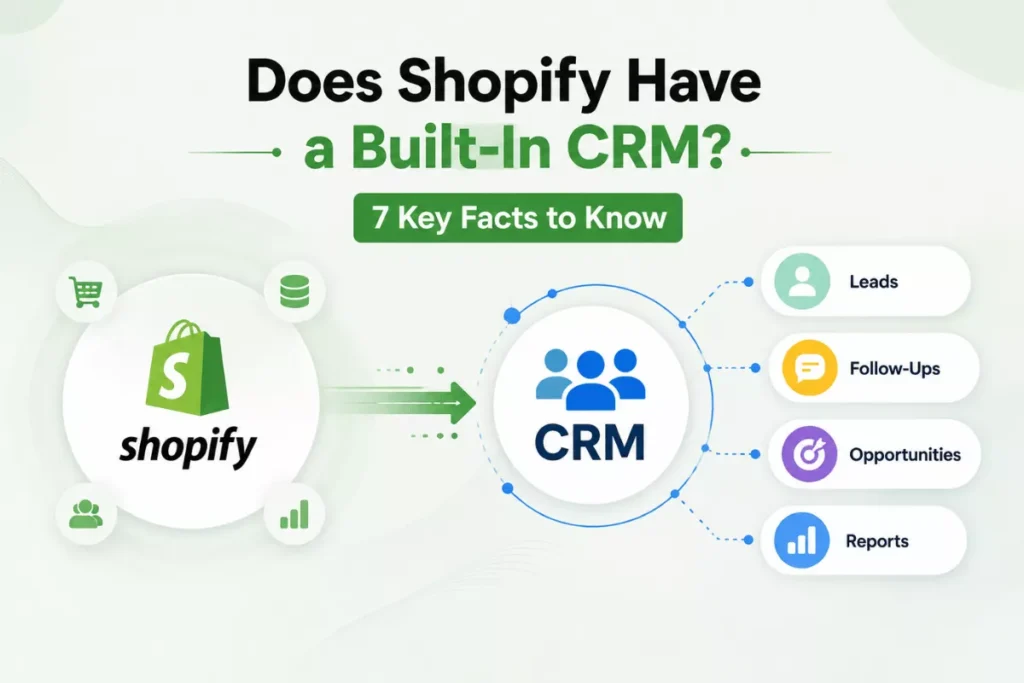
Does Shopify Have a Built-In CRM? 7 Key Facts to Know
If you run a Shopify store, you already have access to customer profiles, order history, customer segments, and customer-related reports. These tools are useful for understanding who your customers are and what they have purchased.
But there is an important distinction: Shopify is primarily an ecommerce platform, not a traditional dedicated CRM system.
Shopify’s customer tools let merchants manage customer information, view order history, create segments, and understand purchasing behavior. Shopify’s own documentation also provides CRM integration options for merchants who need more advanced relationship-management capabilities.
So, does Shopify have a built-in CRM? The practical answer is no—not in the same sense as a dedicated CRM with sales pipelines, lead ownership, opportunity management, custom workflows, and broader relationship-management processes.
That difference becomes more important as your store grows and customer interactions become more complex.
ZemNeo Tip: If your business needs to manage leads, customers, opportunities, tasks, and follow-ups beyond ecommerce orders, a customizable CRM can give your team a more structured customer-management process.
What Customer Management Features Does Shopify Provide?
Shopify does provide several features that can feel similar to CRM functionality.
For example, Shopify automatically creates customer profiles when shoppers interact with a store in certain ways, and merchants can view customer information and order history from the Shopify admin. Customer segments can also be used to group shoppers based on characteristics or purchasing behavior.
Shopify customer accounts also allow shoppers to view their orders, manage profile information, and access other account functions.
These features are useful for ecommerce operations, but they are different from having a complete CRM for managing the broader sales relationship.
| Shopify Customer Tools | Dedicated CRM Capabilities |
|---|---|
| Customer profiles | Detailed contact management |
| Order history | Sales and opportunity history |
| Customer segments | Lead and customer segmentation |
| Customer reports | Sales and performance dashboards |
| Ecommerce customer data | Leads, contacts, accounts and opportunities |
| Store-focused automation | Custom sales and follow-up workflows |
This distinction is why a Shopify store can eventually benefit from connecting its ecommerce data with a dedicated CRM.
What Shopify Does Not Replace With Its Customer Tools
A traditional CRM is generally designed around the complete relationship between a business and its prospects or customers.
If you are wondering Does Shopify Have a Built-In CRM, the key point is to look beyond customer profiles and order history. A full CRM is built to manage the sales activities that happen before, during, and after a purchase.
For example, a sales team may need to know:
Who owns this lead?
When should the sales representative follow up?
What stage is the opportunity in?
What was discussed during the last conversation?
Which tasks are pending?
How much potential revenue is sitting in the pipeline?
These are different questions from “What did this customer order?”
Shopify’s customer tools are strong around ecommerce customer and order information, while dedicated CRM systems can provide sales pipelines, opportunity tracking, task management, and relationship workflows.
Shopify itself explains that merchants can connect Shopify with CRM platforms when they need customer, order, marketing, and service data to work together.
Shopify provides customer and order information that merchants can use to understand their customers and manage their ecommerce operations. You can learn more about Shopify’s customer management capabilities in the Shopify Help Center.
ZemNeo Tip: ZemNeo’s Opportunity Management can be useful when your team needs to manage potential deals beyond completed Shopify orders.
When Is Shopify Customer Management Enough?
Not every Shopify business needs a separate CRM.
If you operate a small store with a straightforward sales process, Shopify’s existing customer features may be enough for basic customer management.
If you’re asking Does Shopify Have a Built-In CRM, the answer depends on what you expect from your customer management system. For basic ecommerce customer records and order information, Shopify can cover many everyday needs. However, businesses with a structured sales process may eventually need dedicated CRM capabilities.
Shopify can be a reasonable starting point when you mainly need to:
- View customer profiles
- Review purchase history
- Segment customers
- Understand new and returning customers
- Manage customer accounts
- Analyze ecommerce customer data
Shopify also provides customer reports covering information such as order counts, average order totals, returning customers, and total customer spending.
The situation changes when customer management involves multiple salespeople, enquiries, follow-ups, sales opportunities, or tasks that need to be assigned and tracked.
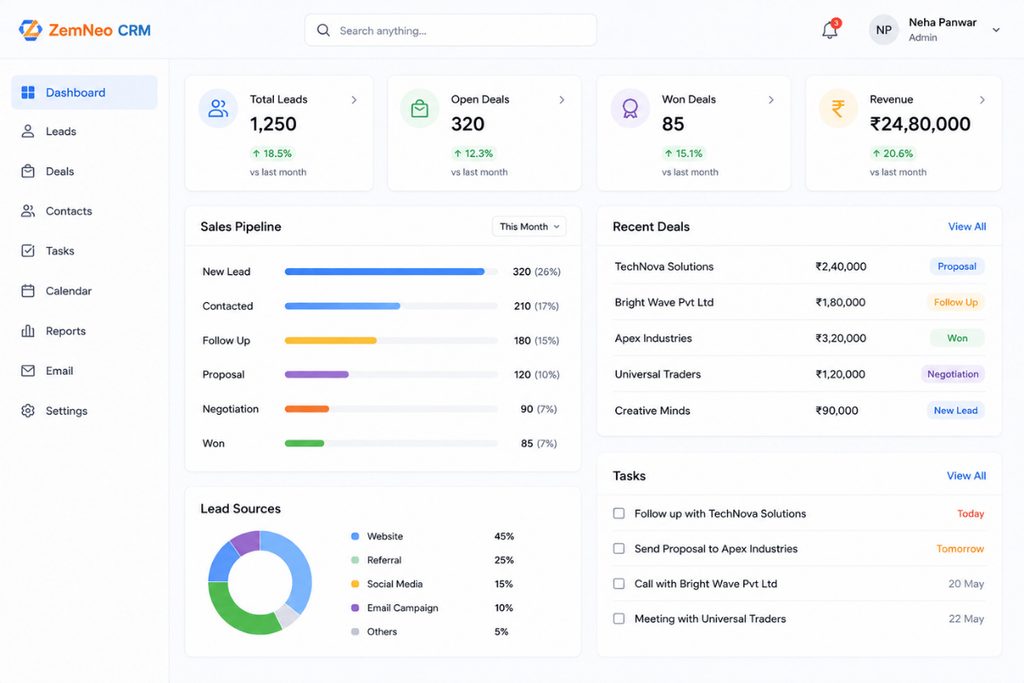
ZemNeo Tip: If your Shopify store is generating enquiries from multiple channels, ZemNeo’s Lead Management can help your team organize leads, assign them automatically, and manage follow-ups from one CRM.uiries from different channels, manual follow-ups, B2B sales, or a sales pipeline that exists outside the checkout process.
When Should a Shopify Store Add a Dedicated CRM?
The need for a dedicated CRM usually appears when customer management becomes more complicated than simply tracking orders.
If you are still wondering Does Shopify Have a Built-In CRM, the more important question is whether Shopify alone can handle your complete sales process. Once your team needs to manage prospects, follow-ups, sales opportunities, and multiple customer conversations, a dedicated CRM can fill those gaps
Here are some common signs.
You Have Leads Before They Become Customers
Not every potential customer begins with a Shopify order.
You may receive enquiries through WhatsApp, Facebook, Instagram, Google Ads, phone calls, website forms, or other channels. These prospects need to be captured and followed up before they ever become Shopify customers.
A dedicated CRM can give sales teams a place to manage these prospects instead of waiting for an order to appear.
ZemNeo’s Lead Management helps businesses organize leads and manage them through a structured process.
Your Team Is Missing Follow-Ups
A customer may ask for pricing today and be ready to purchase next week. If that follow-up exists only in someone’s memory or a spreadsheet, it is easy to miss.
ZemNeo supports automated lead assignment and follow-up reminders, helping teams create a more consistent follow-up process.
For businesses already struggling with spreadsheet-based follow-ups, our guide on managing customer follow-ups without Excel explains why a structured process can be more reliable.
You Have Multiple Salespeople
As the team grows, customer ownership becomes important.
A CRM can help answer questions such as who is responsible for a lead, which opportunities are active, and which tasks are overdue.
This becomes especially useful when a customer speaks with more than one person during the buying process.
You Need Custom Sales Workflows
Different businesses sell differently.
A retail business may have a short buying cycle, while a healthcare, education, finance, hospitality, or manufacturing business may have several stages before a customer makes a decision.
Shopify’s ecommerce workflow does not necessarily match these sales processes.
A customizable CRM allows businesses to create their own pipelines, fields, forms, and workflows around how their team actually sells.
ZemNeo Tip: ZemNeo is built for small businesses across retail, education, healthcare, finance, hospitality, and manufacturing, allowing teams to customize CRM processes instead of relying on one fixed sales workflow.
Shopify CRM Integration: How Does It Work?
You do not necessarily have to choose between Shopify and a CRM.
If you are asking Does Shopify Have a Built-In CRM, integration is an important part of the answer. Shopify can handle ecommerce activities while a dedicated CRM can manage the wider sales relationship, allowing both systems to serve different parts of the customer journey.
The two can work together.
Shopify’s own 2026 CRM integration guide explains that merchants can connect Shopify with CRM platforms to synchronize customer, order, marketing, and service information. It also discusses native integrations, third-party integrations, iPaaS platforms, APIs, and custom connections.
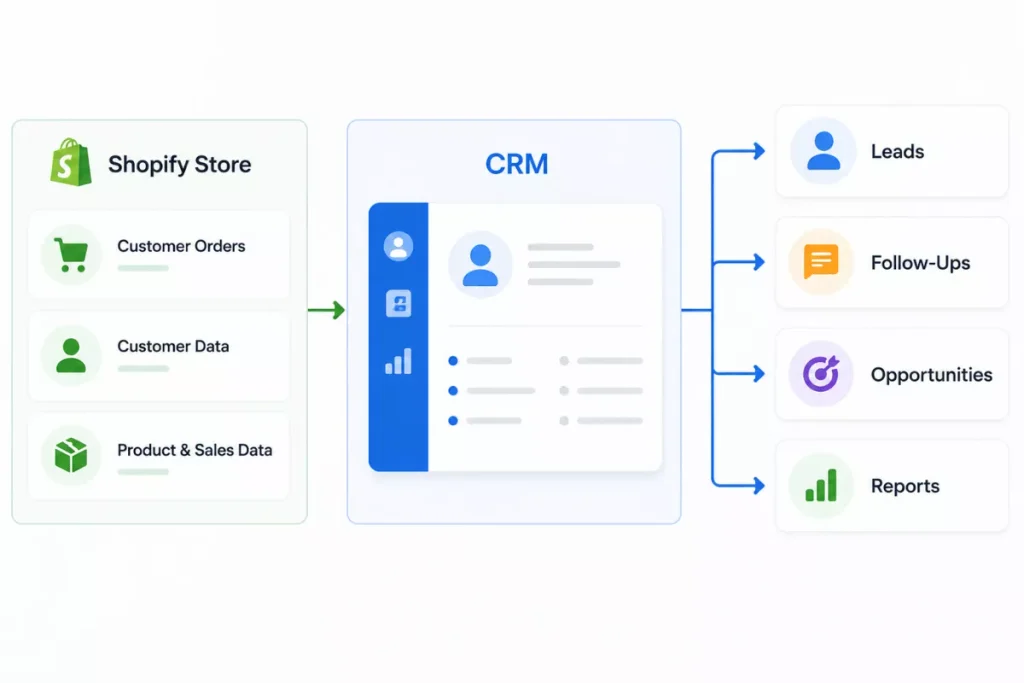
The basic idea is simple:
Shopify → Customer & Order Data → CRM → Sales & Relationship Management
For example, a customer may place an order through Shopify. That customer information can then be connected with CRM data so your team has a broader view of the relationship.
This becomes particularly useful when a business communicates with customers through multiple channels.
ZemNeo supports integrations such as WhatsApp, Google Ads, Facebook, Instagram, SMS, Tally, and CTI calling, allowing businesses to connect important customer and communication processes with their CRM environment.
For businesses using WhatsApp heavily, WhatsApp CRM integration can be particularly relevant when customer conversations need to remain connected to the broader customer-management process.
ZemNeo Tip: The goal of integration should not be to collect more data. The real benefit comes from making useful customer information available to the people who need it at the right stage of the sales process.
Shopify vs Dedicated CRM: What Is the Difference?
The simplest way to understand the difference is to look at the job each system is designed to perform.
| Business Requirement | Shopify | Dedicated CRM |
|---|---|---|
| Ecommerce store management | Strong | Not the primary purpose |
| Product and order management | Strong | Can complement |
| Customer profiles | Yes | Yes |
| Purchase history | Yes | Can be connected |
| Lead management | Limited | Strong |
| Sales pipeline | Limited | Strong |
| Opportunity management | Limited | Strong |
| Follow-up workflows | Some options | Strong |
| Salesperson ownership | Limited | Strong |
| Custom CRM fields and processes | Limited | Strong |
| CRM reporting | Customer-focused | Sales and business-focused |
Shopify itself notes that its built-in customer tools cover common workflows, while dedicated CRM or clienteling tools become more useful when businesses need sales pipelines, advanced workflows, specialized reporting, or external system connections.
Can You Use ZemNeo With a Shopify Business?
Yes, a Shopify business can use ZemNeo as its CRM environment when it needs broader customer and sales management capabilities.
The important point is that Shopify and a CRM can serve different purposes.
Shopify manages the ecommerce side.
ZemNeo can manage the customer relationship and sales process around it.
For example, a growing online retailer might receive enquiries through Google Ads, Facebook, Instagram, WhatsApp, and phone calls. Instead of managing these interactions separately, the business can use CRM processes for lead management, follow-ups, opportunities, contacts, accounts, tasks, and reporting.
ZemNeo also provides Reports & Dashboards so businesses can organize important performance information and make decisions using structured data.
Why a Customizable CRM Can Be Better for a Growing Shopify Business
The biggest advantage of a dedicated CRM is not simply storing more customer information.
It is the ability to build a process around that information.
For example, a business can create a workflow where a new enquiry is automatically assigned to the appropriate team member. The salesperson receives a follow-up reminder, records the interaction, moves the opportunity through a custom pipeline, and management can later review the results through reports.
That is very different from simply knowing that a customer purchased a product three months ago.
ZemNeo provides features such as Lead Management, Auto Follow-Ups, Task Management, Opportunity Management, Contact Management, Account Management, Product Management, Reports & Dashboards, and Role Based Access.
This makes it possible for a small business to build a CRM process around its actual workflow.
Should You Use Shopify Alone or Shopify With a CRM?
The answer depends on the complexity of your customer journey.
If your primary requirement is running an online store and understanding customer orders, Shopify’s built-in customer tools may be sufficient.
If your business has a growing sales team, enquiries from multiple channels, recurring follow-ups, B2B customers, or a sales process that exists outside the online checkout, adding a CRM can make the overall process much easier to manage.
A useful way to decide is to ask:
“Do I only need to know what customers bought, or do I also need to manage how customers become customers?”
If the second question describes your business, a dedicated CRM deserves consideration.
Final Verdict: Does Shopify Have a Built-In CRM?
So, does Shopify have a built-in CRM? Shopify has useful customer-management capabilities, including customer profiles, order history, segmentation, customer accounts, and reporting. These features cover many basic customer-management needs.
However, Shopify is not a replacement for every dedicated CRM use case. When a business needs lead management, sales pipelines, opportunity tracking, structured follow-ups, custom workflows, or broader customer relationship management, a dedicated CRM can fill that gap.
For a growing Shopify business, the best approach may not be Shopify versus CRM. It can be Shopify plus CRM, with each system handling the part of the business it is best suited for.
Key Takeaways
- Shopify provides customer profiles, order history, segmentation, accounts, and customer reports.
- Shopify is primarily an ecommerce platform rather than a traditional dedicated CRM.
- A separate CRM becomes more useful when you need lead and opportunity management.
- Multiple communication channels can make dedicated CRM management more valuable.
- Shopify can be integrated with external CRM platforms.
- ZemNeo provides customizable pipelines, fields, forms, workflows, automation, lead management, opportunity management, and reporting.
- The right setup depends on whether your business only needs customer order data or needs to manage the complete customer journey.
FAQs
Does Shopify have a built-in CRM?
Shopify has built-in customer-management features such as customer profiles, order history, customer segmentation, customer accounts, and customer reports. However, it does not function as a full traditional CRM for every sales and relationship-management requirement. Businesses that need dedicated lead management, sales pipelines, opportunity tracking, and custom CRM workflows may use an external CRM alongside Shopify.
Is Shopify a CRM or an ecommerce platform?
Shopify is primarily an ecommerce platform. It provides customer-management functionality as part of the Shopify admin, but its core purpose is helping businesses run online commerce. A dedicated CRM is designed more specifically around managing leads, sales opportunities, customer relationships, follow-ups, and sales processes.
Can Shopify be connected to a CRM?
Yes. Shopify supports CRM integrations, and its official resources describe ways merchants can connect Shopify with CRM platforms using native integrations, third-party connectors, APIs, and other integration approaches.
Why would a Shopify store need a CRM?
A Shopify store may need a CRM when customer management becomes more complex than tracking orders. For example, if a business receives leads from WhatsApp, Facebook, Instagram, Google Ads, website forms, or phone calls, a CRM can provide a structured way to assign, follow up, qualify, and manage those prospects before they become customers.
Can Shopify replace a CRM for a small business?
For some small stores, Shopify’s customer features may be enough. If the business mainly needs customer profiles, order history, segmentation, and basic customer reporting, a separate CRM may not be necessary. As sales teams, communication channels, and follow-up requirements grow, a dedicated CRM can become more useful.
What is the benefit of integrating Shopify with a CRM?
Integration can connect ecommerce information with broader customer and sales processes. For example, customer and order information can be available alongside sales activities, follow-ups, and other relationship data. This reduces the need to manage customer information across completely separate systems.
Is a CRM useful if I already have Shopify customer profiles?
Yes, if your team needs to manage more than customer and order information. Shopify customer profiles are useful for understanding shoppers and their purchasing history, while a CRM can add lead ownership, sales pipelines, opportunity tracking, tasks, custom workflows, and follow-up processes.
What CRM features should a growing Shopify business look for?
Look for features that match the way your team actually sells. Lead management, opportunity management, automated follow-ups, contact and account management, reporting, customizable workflows, and communication integrations can be valuable when a Shopify business has a more complex sales process.
Ready to Manage More Than Shopify Orders?
If your Shopify business is growing and you need a more structured way to manage leads, customer relationships, opportunities, and follow-ups, ZemNeo can help you build a CRM process around your business.
Book a Free Demo and see how ZemNeo can fit your customer-management workflow.