Zemneo vs Traditional ERPs and CRMs: Which One Is Best?
Every business reaches a point where spreadsheets and chat groups stop working. Leads come in from WhatsApp, Google Ads, Facebook and phone calls. Notes sit in five different places. Someone says, “We need proper software,” and the demos begin. One vendor shows an ERP with forty modules. Another shows a CRM that needs a consultant before anyone can log in. Months pass, and the sales team still follows up from memory.
This article looks at ERP vs CRM for business and compares Zemneo with traditional ERPs and CRMs. We’ll cover cost, setup time, flexibility, and daily use, so you can pick what fits your team, no matter how big it is.
ERP vs CRM for Business: What Does Each One Actually Do?
People mix these two up all the time, and vendors who bundle them don’t help.
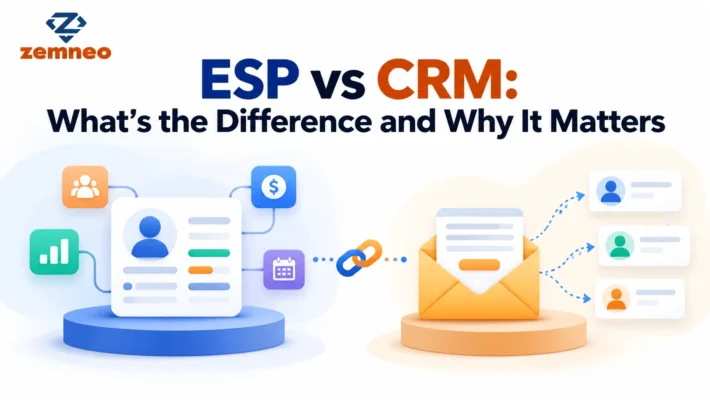
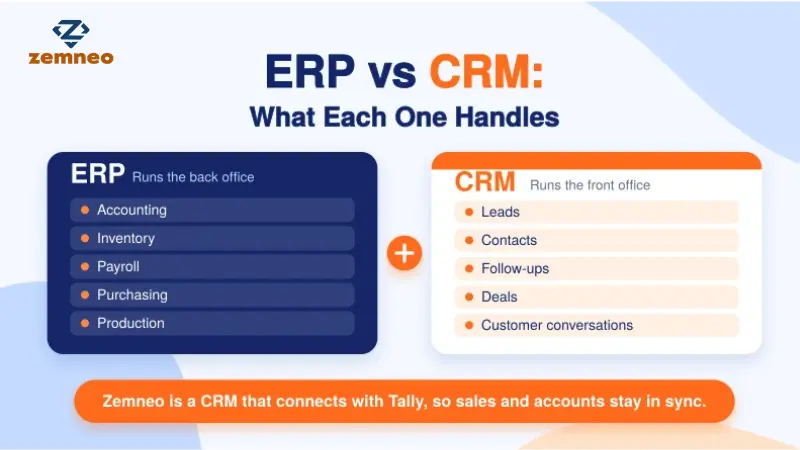
An ERP (Enterprise Resource Planning) system runs the back office. It handles accounting, inventory, payroll, purchasing and production. A CRM (Customer Relationship Management) system runs the front office. It tracks leads, contacts, follow-ups, deals and customer conversations.
Here’s a quick test. If your problem is “we don’t know who to call next” or “that lead went cold and nobody noticed,” you have a CRM problem. If your problem is “our stock count never matches our books,” you have an ERP problem. Many companies only have the first one, yet they end up buying software built for the second.
Where Traditional ERPs and CRMs Fall Short
When you weigh ERP vs CRM for business use, big, established platforms look powerful, and they are. But a few problems show up again and again, no matter how large the company is:
- Slow setup. Many traditional systems take weeks or months to configure. Some need a paid implementation partner before the first lead is entered.
- Layered pricing. The per-user fee is only the start. Add-on modules, integration costs, training and support plans pile up.
- A fixed way of working. You end up changing your sales process to match the software, not the other way around.
- Low adoption. If entering data feels like homework, salespeople skip it. A CRM that nobody updates is just an expensive contact list.
- Features you never use. You pay for forty modules and touch four.
What Zemneo Does Differently
Zemneo is a customizable CRM software platform, and its main idea is simple: the software should adapt to your process. You build your own pipelines, fields, forms and workflows. A retail chain, a coaching institute and a hospital don’t sell the same way, so they shouldn’t be forced into the same template. The customizable CRM page explains how far this goes.
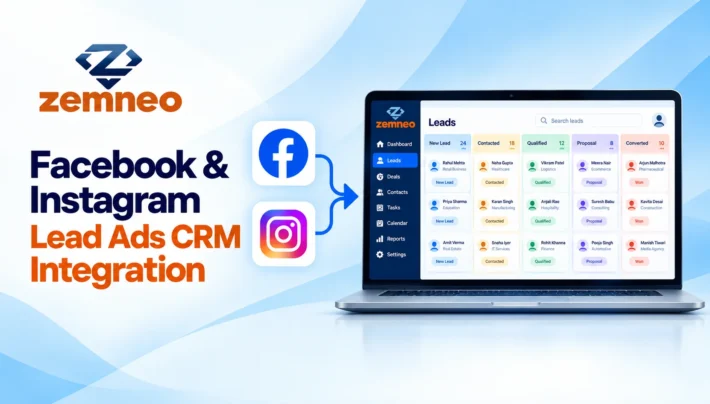
Your channels feed straight in. Zemneo connects with WhatsApp, Google Ads, Facebook, Instagram, SMS and calling systems. A lead who messages you on WhatsApp CRM lands in the same dashboard as one from a Google Ad. Nobody copies and pastes anything.
Accounting stays connected. Many Indian businesses run Tally for their books. The Easy Tally integration links it with your CRM, so sales and accounts stay in sync without a full ERP rollout.
Automation handles the repeat work. New leads get assigned to the right person automatically. Follow-up reminders go out on time. Order updates and payment reminders can go over WhatsApp and SMS. You can read more about CRM automation on Zemneo’s feature pages.
Larger teams get control. When more people use the system, you need to decide who sees what. Role-based access lets you set that per person or per team, and reports and dashboards give managers a clear view of the pipeline without chasing updates.
AI does some of the thinking. Zemneo is also built as an AI CRM software option, with AI that cuts down routine work. It helps the team see which leads deserve attention first and takes repetitive follow-up tasks off their plate. In most teams, the leads that get lost are the ones nobody had time to look at. This is where AI helps most.
ERP vs CRM for Business: Zemneo vs Traditional Systems Side by Side
| Factor | Traditional ERP | Traditional CRM | Zemneo |
| Main job | Accounts, inventory, operations | Sales and customer tracking | Leads, sales and follow-ups |
| Setup time | Weeks to months | Weeks | Short, built around your process |
| Cost | High, with add-ons | Medium to high, per user | Clear and flexible |
| Flexibility | Rigid, needs consultants | Moderate | Custom pipelines, fields and workflows |
| Learning curve | Steep | Moderate | Simple dashboard, easy for sales teams |
| Best for | Complex back-office operations | Dedicated sales organizations | Teams of any size that sell through leads and enquiries |
When a Traditional ERP Is the Right Call
In the ERP vs CRM debate for business, a full ERP wins when your real problem sits in the back office. A full ERP makes sense if you run complex manufacturing with bills of materials, manage stock across several warehouses, or handle accounting for multiple legal entities. In those cases, the back-office complexity is the real problem, and a CRM alone won’t fix it.
Even then, you don’t have to choose one or the other. Many companies run an ERP or accounting tool for operations and a lighter, more flexible CRM for sales. Zemneo’s manufacturing CRM setup is built for that kind of arrangement.
When Zemneo Is the Better Fit
Zemneo tends to work best when:
- Most of your revenue starts with a lead, an enquiry or a phone call.
- Your sales process doesn’t match the standard template. Education, healthcare, finance, retail and hospitality businesses often fall in this group.
- Customers talk to you on WhatsApp, Instagram or Facebook, and those chats get lost.
- You want the system running in days, not after a long rollout.
If three or more of those sound familiar, a customizable CRM will likely give you more value than a large platform with features you won’t touch. For lead-driven teams, the ERP vs CRM for business question usually ends with a CRM.
ERP vs CRM for Business: Four Questions to Ask Before You Choose
1. Where are you actually losing money? Missed follow-ups point to a CRM. Mismatched stock and books point to an ERP. Be honest about which one hurts more right now.
2. Who will use it every day? If the answer is your sales team, test the software with them, not just with management. Ask them to add a lead and set a follow-up. If they struggle, adoption will be low.
3. What does year one really cost? Ask for the full number: licences, setup, training, add-ons and support. Then compare it with a simpler tool.
4. Does it connect to what you already use? A CRM that can’t talk to WhatsApp, your ad accounts or your accounting software will create more manual work, not less.
Frequently Asked Questions
1. What is the main difference between ERP and CRM?
An ERP runs the back office. It handles accounting, inventory, payroll, purchasing and production. A CRM runs the front office. It tracks leads, contacts, follow-ups, deals and customer conversations. Missing follow-ups? You need a CRM. Stock that never matches your books? You need an ERP.
2. Can Zemneo replace an ERP?
No. Zemneo is a CRM, so it focuses on leads, sales and customer communication. Complex manufacturing or multi-warehouse stock still needs an ERP or accounting tool. Many businesses use both. Zemneo connects with Tally, so sales and accounts stay in sync.
3. Is Zemneo a good fit for larger teams?
Yes. Zemneo supports role-based access, so you decide who sees what. Reports and dashboards give managers a clear view of the pipeline. You can also build separate pipelines, fields and workflows for different teams or branches.
4. Which channels does Zemneo connect with?
Zemneo connects with WhatsApp, Google Ads, Facebook, Instagram, SMS and calling systems. Leads from all these channels land in one dashboard. Nobody has to copy and paste them by hand.
5. How do I know if I need a customizable CRM instead of a traditional one?
Look at your sales process. If it does not fit a standard template, a customizable CRM is the better pick. The same goes for a team that skips data entry because the tool feels heavy. Zemneo lets you build pipelines and forms around how your team already works. You can try it with a free demo first.
Final Thoughts
The ERP vs CRM for business choice comes down to where your daily friction really is. Traditional ERPs and CRMs are built for scale and complexity. That’s useful when you have both. Most teams just need a system that captures every lead, reminds the team to follow up and shows what’s happening in the pipeline.
That’s the gap Zemneo CRM fills. It’s flexible enough to match your process, connected to the channels your customers already use, and backed by AI that takes routine work off your team. If you want to see how it looks with your own sales process, you can book a free demo with Zemneo and test it on a real use case.