
Why Small Businesses Lose Leads Without Realizing It — And How Lead Management Fixes It
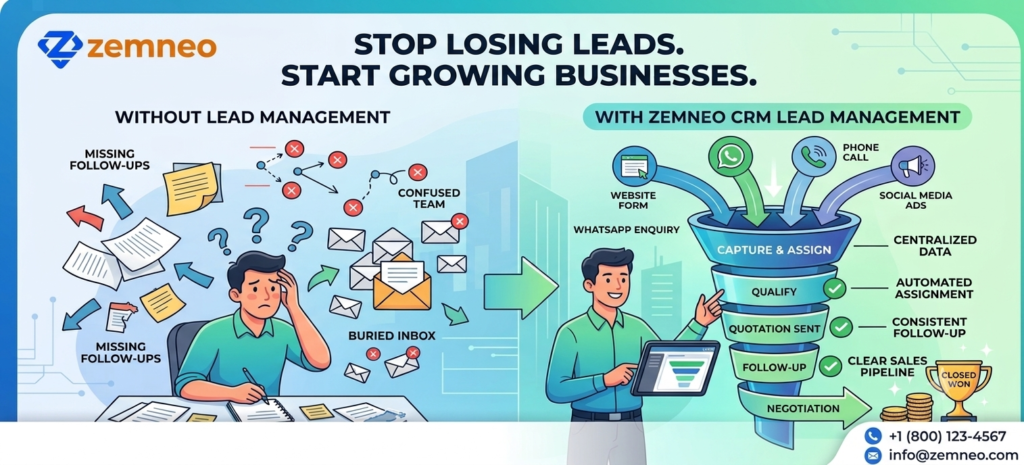
Getting Leads Is Only Half the Job
Getting leads is only half the job.
A customer fills out a website form. Someone sends a WhatsApp enquiry. A prospect calls asking for a quotation. A potential buyer responds to a social media advertisement.
In the middle of a busy workday, someone plans to call back later. Someone else assumes another salesperson is handling it. And then, the lead goes quiet.
Sometimes the customer simply loses interest. Sometimes they choose a competitor who responded first. And often, a business never realizes the opportunity was lost in the first place.
This is why lead management matters. A clear lead management process helps businesses capture every enquiry, assign responsibility, follow up consistently, track the sales pipeline, and understand what happens to each lead from first contact to closing the sale.
What Does “Losing a Lead” Actually Mean?
Leads rarely disappear in an obvious way. More often, they drop out through small operational gaps in the sales process:
- A WhatsApp enquiry gets buried under hundreds of new messages.
- A website form enquiry sits in an inbox without being assigned to anyone.
- A phone enquiry is written in a paper notebook but never added to the official sales pipeline.
- Two salespeople accidentally contact the same customer while another lead receives no response at all.
- A salesperson speaks to a prospect but forgets to follow up after sending a quotation.
- A promising lead remains untouched because nobody knows who owns it.
Each incident may seem small on its own. However, when these gaps happen repeatedly, businesses lose valuable sales opportunities without knowing where they went.
This is one of the biggest challenges for growing companies: leads may be coming in, but there is no consistent system for tracking what happens next.
Why Fast Lead Follow-Up Matters
When someone enquires about a product or service, their interest is highest at that exact moment. The longer a business waits to respond, the greater the chance that the prospect moves on, becomes difficult to reach, or starts talking to competitors.
While ideal response times vary by industry, the core principle remains simple: A lead that arrives today should not become tomorrow’s forgotten task.
As lead volume and sales team size grow, responding quickly and consistently becomes harder to manage manually. A dedicated lead management system helps teams stay on top of new enquiries and immediate next steps.
Why Excel, WhatsApp and Inboxes Eventually Stop Working
Many small businesses start with simple tools such as:
- Excel or Google Sheets
- Email inboxes
- Call records and physical notebooks
Starting this way is completely normal. The problem begins when the business grows and multiple team members start handling leads simultaneously.
- Spreadsheets store data well, but they don’t remind a salesperson: “This prospect needs a call today.”
- Inboxes receive messages, but they don’t automatically clarify: “Who is responsible for this lead?”
- WhatsApp keeps chat history, but it doesn’t offer business owners a high-level view of response times or overall conversion rates.
This is the key difference between storing leads and managing leads. A structured lead management tool brings the entire process together so teams can capture, assign, track, and follow up systematically.
What Does a Lead Management System Actually Do?
A lead management system doesn’t replace your sales team. It helps your sales team avoid the administrative gaps that cause good opportunities to be forgotten.
1. Capture Leads From Multiple Sources
Leads can come from many places:
- Website forms
- Google Ads
- Social media
- Phone calls
- Landing pages
- Events and campaigns
Instead of keeping these enquiries in separate places, a lead management system can bring them into one central view. That gives your team a much clearer picture of the opportunities coming into the business.
2. Assign Every Lead to Someone
A lead should have an owner. When a new enquiry arrives, the system can assign it to the appropriate salesperson based on rules such as location, product, business segment, or availability.
This removes one of the most common sales problems:
“I thought someone else was handling it.”
Automated lead assignment and routing are common CRM capabilities specifically designed to help businesses respond faster and maintain accountability.
3. Make Lead Follow-Up a Process, Not a Memory Test
One of the biggest problems in sales is not always a lack of leads. It’s inconsistent follow-up.
A salesperson might:
- Speak to the customer.
- Send a quotation.
- Plan to call tomorrow.
- Get busy with another customer.
- Forget.
A good lead management process can create a follow-up task or reminder so the next action doesn’t depend entirely on memory. That doesn’t mean every follow-up should be automated. It means the system helps your team remember when to act, while the salesperson decides how to communicate.
4. Give Everyone a Clear View of the Sales Pipeline
Instead of asking your sales team:
“What happened to that lead?”
A manager should be able to see it.
For example: New → Contacted → Qualified → Quotation Sent → Follow-Up → Negotiation → Won/Lost
This makes it easier to identify leads that are moving forward and leads that have become stuck in your sales pipeline.
5. Track Lead Sources and Conversion
Getting 500 leads sounds impressive. But what if only five become customers?
Lead management should help you understand:
- Which channel generated the lead?
- How many leads came from each source?
- How quickly were they contacted?
- How many were qualified?
- How many received quotations?
- How many became customers?
- What was the value of those customers?
This helps businesses make better marketing decisions instead of simply chasing lead volume.
What Does Good Lead Management Look Like?
A simple lead management process might look like this:
Step 1 — Lead arrives
A customer submits a website enquiry, sends a WhatsApp message, calls, or responds to a campaign.
Step 2 — Lead is captured
The customer’s details are added to the CRM automatically or entered by the team.
Step 3 — Lead is assigned
The right salesperson becomes responsible for the enquiry.
Step 4 — First response
The salesperson contacts the customer as quickly as possible.
Step 5 — Follow-up is scheduled
If the customer is not ready to buy, the next action is recorded.
Step 6 — Sales stage is updated
The lead moves through the pipeline as the conversation progresses.
Step 7 — Result is recorded
The lead becomes a customer, remains in follow-up, or is marked as lost.
This creates something every growing business needs: accountability.
Everyone knows what happened, what needs to happen next, and who is responsible.
A Simple Example: How Much Can a Missed Lead Cost?
Imagine a business receives 100 leads per month.
If 20 leads are effectively lost because of slow response, poor follow-up, or lack of ownership, that represents 20 sales opportunities that may never receive a proper chance.
If the average customer is worth ₹15,000:
20 missed opportunities × ₹15,000 = ₹3,00,000 in potential revenue
The actual impact will vary from business to business. The important point is that businesses often focus heavily on generating more leads before fixing what happens to the leads they already have.
Sometimes the fastest way to improve sales is not to generate more enquiries. It is to stop losing the ones you are already getting.
When Should a Small Business Start Using a CRM?
You do not need a CRM simply because you have a business. A spreadsheet may be perfectly adequate when you have very few leads and one person handles the entire sales process.
But it may be time to consider a lead management system when:
- Your team receives leads from multiple channels.
- More than one salesperson handles enquiries.
- Leads are being forgotten or followed up late.
- Managers do not know the current status of every opportunity.
- Salespeople maintain separate lead lists.
- Customers have to repeat information because previous conversations are not visible.
- You are spending money on advertising but do not know which leads actually convert.
- Your business is growing and manual tracking is becoming difficult.
The goal is not to introduce complicated software. The goal is to introduce enough structure so your team can consistently manage the opportunities already coming into the business.
How Zemneo Helps Businesses Manage Leads
This is where Zemneo fits into the picture.
Zemneo CRM is designed to help growing businesses bring their lead management process into one place.
Instead of keeping enquiries scattered across spreadsheets, inboxes, and individual conversations, businesses can use Zemneo to:
- Capture leads from different sources
- Assign leads to salespeople
- Track the sales pipeline
- Schedule follow-ups
- Monitor salesperson activity
- Track lead sources
- See which leads are pending
- Understand conversion performance
With a centralized lead management process, your team can spend less time searching for information and more time acting on sales opportunities.
The goal is simple:
Every lead should have an owner.
Every important lead should have a next action.
And every business owner should be able to see what is happening.
The Real Problem Isn’t Always Getting More Leads
Businesses spend a lot of time and money trying to generate more enquiries through Google Ads, social media, website campaigns, referrals, events, and partnerships.
But generating more leads does not solve a broken follow-up process.
If 100 new leads enter your business and your team struggles to manage them, generating another 100 may simply create a bigger problem.
A better approach is to build a system where every lead gets a fair opportunity to become a customer.
Capture it.
Assign it.
Follow up.
Track it.
Learn from it.
That is what effective lead management is really about.
Stop Letting Good Leads Go Quiet
Your next customer may already be sitting in your WhatsApp inbox, website form, email inbox, or salesperson’s spreadsheet.
The question is:
Will your team follow up before someone else does?
See how Zemneo can help your team capture, assign, track, and follow up with leads in one place. Book a free Zemneo demo
